What Is a Mini Telehandler: Practical Selection and Rental Guide 2026
This article introduces the definition, applicable scenarios, and selection guidelines for mini telehandlers, helping you construct efficiently.
In the cramped spaces of old residential area renovation sites, where large equipment struggles to enter, a mini telehandler can move nimbly. It precisely delivers building materials from the ground to balconies on upper floors and can quickly switch attachments to stack materials. Whether it's material transport for self-built houses in rural areas or small-scale hoisting for interior decoration, this type of equipment always operates efficiently in confined spaces. The following will provide a detailed introduction to its definition, typical use cases, and a practical selection/rental guide to help you choose the right equipment to meet your construction needs.
What Is a Mini Telehandler?
Definition
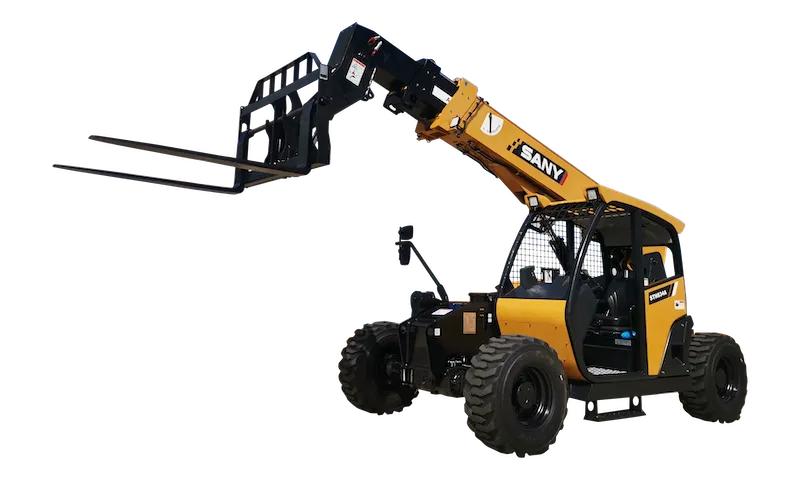
A mini telehandler, also known as a small telehandler or compact telehandler, is a multi-functional telescopic forklift designed specifically for confined spaces. It is compact, lightweight, and offers excellent flexibility and maneuverability. It can be easily towed by pickup trucks or trailers, making it suitable for work environments with limited space and strict size requirements. Although its height is less than that of full-size models, it possesses the lifting capacity of a telescopic forklift, making it an all-around work equipment.
Main Features
Size: Compact design, typically less than 2 meters in width and height, allowing them to pass through narrow doorways or gates. Mini telehandlers have a rated lifting capacity of approximately 1.2 to 2.5 tons and a lifting height of typically 4-7 meters, which differs significantly from conventional telehandlers.
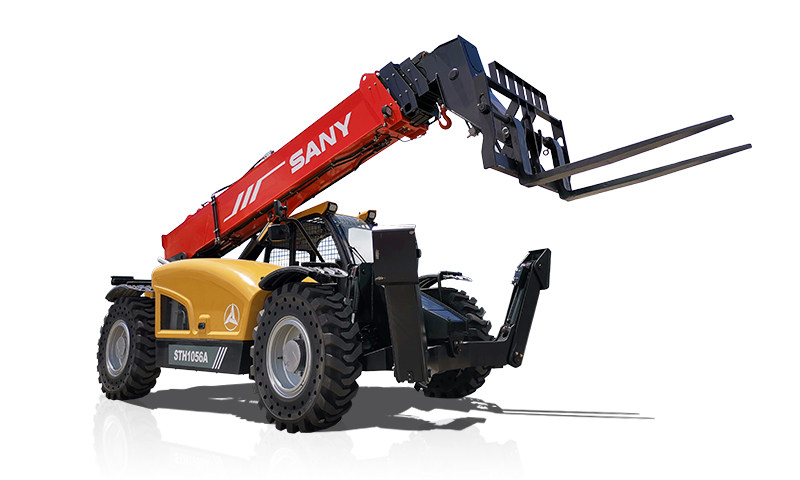
For example, SANY telehandlers have a maximum lifting height of 10-17.1 meters and a rated lifting capacity of 2.7-5.5 tons.
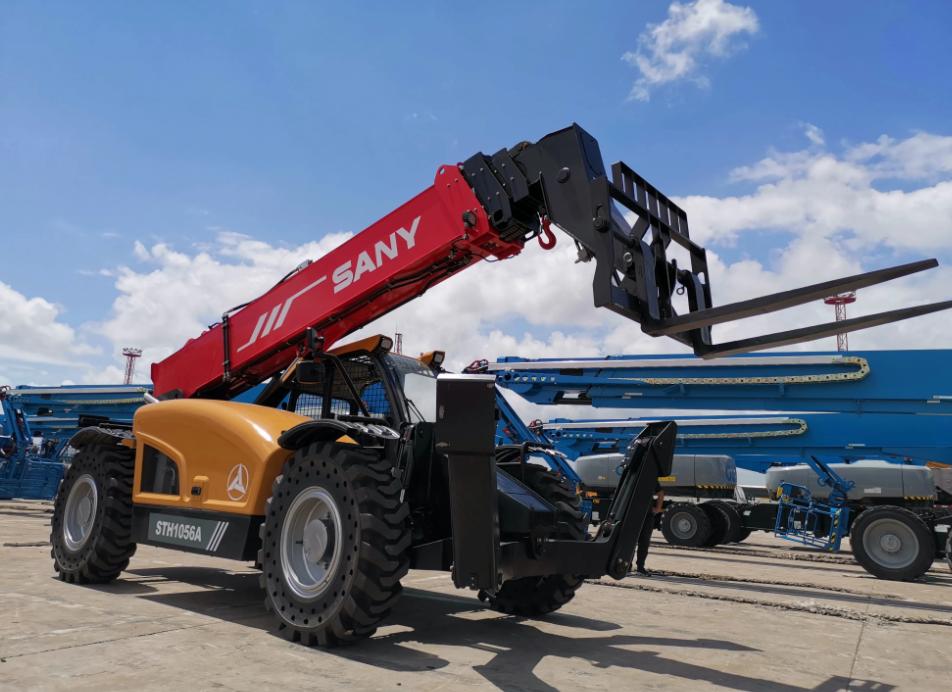
Versatility: Compatible with various attachments such as forks, buckets, and grapples.
Performance: Combines the features of a forklift, mini crane, and skid steer loader, enabling it to lift materials over obstacles.
Maneuverability: Equipped with an all-wheel steering system, it can navigate in tight, enclosed spaces.
Three Steering Modes
The compact telescopic boom forklift is equipped with three steering modes: four-wheel steering, two-wheel steering, and crab steering, adapting to the steering needs of different operating scenarios:
Two-wheel steering: The standard steering mode, meeting the steering needs of open areas and regular driving, is easy to operate and suitable for daily operations.
Four-wheel steering: All four wheels participate in steering simultaneously, significantly reducing the turning radius, making it suitable for flexible steering in narrow spaces and limited areas.
Crab steering: Achieves lateral movement without rotating the machine body, enabling precise adjustment of the equipment and load position, making it the optimal choice for operations in confined spaces and precise positioning.
Optional Attachments
The mini telescopic boom forklift can be equipped with a variety of specialized attachments to achieve multi-functional operation. The core compatible attachments and their uses are as follows:
General-purpose bucket: For handling loose materials such as sand, soil, gravel, and waste.
Pallet forks: For basic material handling, truck unloading, and other conventional forklift operations.
Bale forks: For farm use, transporting hay and silage.
Hydraulic grab bucket: For grabbing and processing waste, timber, and demolishing debris.
Sweeper: For quickly cleaning roads, construction sites, and other surface areas.
Auger: For drilling operations, suitable for fencing installation, planting, and other scenarios.
What Scenarios Are Suitable for the Mini Telehandler?
With its compact size and high flexibility, the mini telehandler can adapt to various space-constrained work scenarios. It can also be equipped with various accessories to achieve multi-functional operation, covering multiple fields such as construction, agriculture, and landscaping. It has significant advantages in working in confined spaces and low ceilings, becoming a practical tool for efficient operations across various industries. Specific applicable scenarios can be divided into the following categories:
1. Indoor Material Handling
Suitable for indoor settings such as warehouses and shopping malls, it can efficiently move materials such as tile and plasterboard pallets, adapting to limited indoor work spaces.
2. Urban Construction
It plays a vital role in construction scenarios between urban streets and buildings. Its small turning radius adapts to the narrow working environment of cities, meeting space constraints.
3. Agricultural Production Operations
It can access areas inaccessible to large equipment, such as livestock sheds and greenhouses to complete material handling and operational tasks related to agricultural production.
4. Landscape and Site Maintenance
Used for landscaping and site maintenance in gardens and golf courses, for transporting soil, plants, tools, etc. The lightweight design reduces ground damage from rolling.
5. Industrial Equipment Maintenance
Suitable for industrial settings with low ceilings, such as factories, it can elevate technicians or allow for flexible movement in high-altitude operations and confined spaces.
What Are the Differences Between a Mini Telehandler and a Regular Forklift?
The design intent and operational adaptability of a mini telehandler are completely different from those of a regular forklift. It's not simply a functional upgrade. The former breaks through the limitations of terrain and operational dimensions, making it more suitable for complex and diverse work scenarios, while the latter focuses on standardized vertical material handling in warehousing. The core differences between the two are mainly reflected in three aspects:
Terrain Adaptability
The mini telehandler has four-wheel drive, a swing axle, and high ground clearance, enabling stable operation on rough, soft, unpaved surfaces; regular forklifts are only suitable for paved warehouse surfaces and are prone to getting stuck and unable to operate normally outside of these areas.
Operating Range
Mini telehandlers typically have over 350mm of ground clearance, all-wheel drive, and a telescopic boom for high vertical lifting and long horizontal reach, enabling them to operate across obstacles. Ordinary forklifts, on the other hand, use a mast-type vertical lift with no horizontal reach, limiting their operating range.
Handling and Design
Mini telehandlers have a small turning radius of less than 4 meters, offering greater flexibility in confined spaces. While sacrificing some maximum lifting capacity, this translates to greater adaptability to various scenarios. Ordinary forklifts (especially heavy-duty models) have superior lifting capacity but are less adaptable to different spaces and terrains.
Mini Telehandler: Buy or Rent?
As a versatile tool for space-constrained environments, the choice between buying and renting a mini telehandler depends primarily on usage frequency, work cycle, budget, and maintenance capabilities. There's no need to blindly pursue ownership, nor to rely solely on renting. Weighing the pros and cons based on your actual needs is key to maximizing cost-effectiveness. The following will break down the applicable scenarios and core considerations for both options.
Suitable Scenarios for Renting a Mini Telehandler
Renting is the optimal solution for short-term, temporary use scenarios, especially suitable for individuals or SMEs who do not need to occupy the equipment long-term and wish to avoid additional costs and risks. It aligns with the asset-light operation concept and is specifically suitable for the following scenarios:
-Short-term/One-off Projects: For single-project work or short-term projects within 3 months, leasing is more economical. Payments are made daily/weekly/monthly, and the equipment can be returned upon project completion, avoiding equipment idleness and capital tie-up, and eliminating the high upfront costs of purchase.
-Limited Funds and Avoidance of Hidden Costs: Equipment has a high unit price, requires a one-time investment, and comes with hidden costs such as annual maintenance and depreciation (2%-5% of the equipment value), with significant depreciation after 3 years. Leasing transfers all hidden costs, eliminating the need for a maintenance team and spare parts inventory.
-Versatile operating scenarios: Leasing allows for flexible adaptation to different load-bearing capacities, lifting heights, and accessory requirements, enabling users to rent the latest equipment at any time, avoiding the problem of outdated technology and redundant purchases.
-Savings on transportation/training/compliance costs: Leasing includes the company's equipment transportation and operator training services, meeting OSHA certification requirements, mitigating compliance risks, and eliminating the need to handle related matters independently.
Suitable Scenarios for Purchasing a Mini Telehandler
This purchase is more suitable for users who use the device long-term and frequently, want to have control over its use, and seek long-term cost-effectiveness. It is especially suitable for enterprises or individuals with stable operational needs. Specifically, it is suitable for the following scenarios:
-Long-term, high-frequency operations: For applications requiring over 6 months of use per year with stable operating cycles (such as landscaping, farm operations, and routine warehouse handling), long-term purchase offers better value, with accumulated costs significantly lower than long-term leasing. Residual value gains are also available, increasing ROI.
-Requires 24/7 flexible deployment: Avoids the issues of equipment shortages and reservation requirements during peak rental seasons. Suitable for emergency repairs, sudden moving requests, and other unpredictable operations, allowing for greater control over usage and preventing equipment shortages from impacting progress.
-For customized operations: Equipment configurations can be tailored to specific scenarios, addressing the issues of standardized rental equipment and limited accessory selection. Customized configurations further enhance operational efficiency.
-For business expansion: Purchasing equipment represents asset accumulation in building a fleet of owned equipment. This not only meets the company's own operational needs but also allows for rental income generation when not in use, aligning with long-term business development plans.
Conclusion
The mini telehandler, as a versatile tool for working in confined spaces, has become the preferred equipment in many industries such as construction, agriculture, and landscaping due to its compact size, flexible operation, and versatility. When choosing a mini telehandler, considering your own work scenario, usage frequency, and budget, you can leverage its space adaptability advantages while achieving an optimal balance between cost and efficiency, allowing this multifunctional device to truly help carry out various tasks efficiently.
FAQs
How Much Can a Mini Telehandler Lift?
The maximum rated lifting capacity of a mini telehandler forklift ranges from 2700 to 5500 pounds. Ultra-compact models have a lower lifting capacity within this range, while larger compact models can reach a maximum lifting capacity of 5500 pounds. It is important to note that the actual lifting performance of the equipment should be based on the load chart provided by the manufacturer, especially with the boom at maximum extension.
How Big Is the Mini Telehandler?
Mini telehandlers typically measure 5 to 6.5 feet wide and 6.5 to 7.5 feet high, weighing between 5,000 and 6,000 pounds. They generally offer a maximum lifting height of 13 to 20 feet, a load capacity of 3,000 to 5,500 pounds, and are designed for narrow, confined spaces.
What Is the Difference Between a Mini Telehandler And a light-duty telehandler?
The mini telehandler is an ultra-compact sub-model of the light-duty telehandler. The core differences between the two lie in size and mobility, as well as their operating and application range: the former is less than 2 meters wide and high, making it suitable for small/specially restricted spaces, primarily for landscaping, residential and indoor operations, with lower load and operating height; the latter is more robust, suitable for light commercial buildings, material stacking and rugged terrain, with higher load-bearing capacity.
Featured Products
Recommend Blogs
What Is a Telehandler? Key Functions, Principles & Application Scenarios
This article explains what a telehandler is, outlining its components, functions, uses, and types. It also compares telehandlers with forklifts and cranes to help you choose the right equipment.
What Is a Telehandler? How It Works and Why It’s a Must-Have Machine
Learn what a telehandler is, how it works, and how to choose the right model for your job in this practical, easy-to-follow guide.