How to Choose a Telehandler? Pick the Perfect Model for Your Job
How to choose a telehandler? This guide covers definitions, types, applications, and key considerations to help you select the right model.
In construction, agriculture, warehousing, and other fields, telehandlers are core equipment for material handling and high-altitude operations. They feature flexible extension, heavy-load capacity, and suitability for various terrains, and come in diverse models and with various attachments to meet different application needs. However, with a variety of models and complex scenarios, many people are unsure how to choose a telehandler. This article analyzes relevant knowledge from the perspectives of definition, core components, and model classification, providing guidance on equipment selection.
_141253.png)
Understanding Telehandler Basics
What is a telehandler?
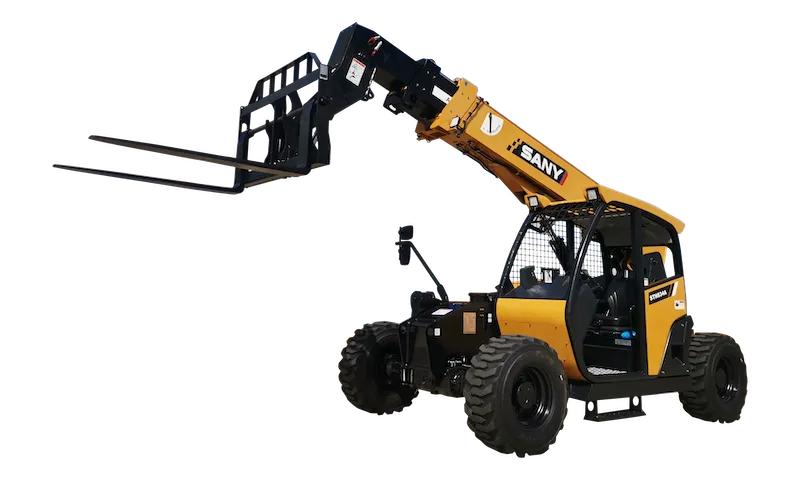
A telehandler can be understood as a combination of a forklift and a crane. Its core feature is a long arm that can extend forward and upward. This arm can be equipped with various attachments such as forks and buckets, depending on the work requirements. It can stably perform lifting, moving, and placing heavy objects, and can lift heavy objects to higher and farther positions than ordinary forklifts. This machine is designed to be robust and durable, often featuring four-wheel drive, allowing it to operate flexibly on uneven terrain. It is a highly practical material handling and lifting equipment.
Core Components of a Telehandler
- Telescopic Boom: The most recognizable and core working component, featuring a multi-section nested extendable arm made of steel or aluminum. It enables horizontal and vertical movement of materials and directly determines telehandler reach, working height, load capacity, and operational precision.
- Hydraulic System: The power core of the machine, consisting of hydraulic pumps, cylinders, control valves, and other components. It transmits pressure via hydraulic fluid to power boom extension, attachment operation, and machine steering, while ensuring smooth load lifting and lowering. It is the core system for guaranteeing telehandler performance.
- Attachments & Quick Coupler Interface: The key configuration for multi-functional operations, including interchangeable accessories such as forks, buckets, work platforms, hooks, and grapples. Equipped with a standardized quick coupler/interface for rapid installation and removal, it greatly expands the machine’s application scenarios.
- Operator Cab: The control and operating space for the operator, integrating a full set of controls for steering, boom extension, and attachment operation. It is equipped with an ergonomic seat, visibility aids (large windows, rearview cameras), and safety structures.
- Chassis & Undercarriage System: The structure ensuring machine mobility and fundamental stability. The chassis is designed for load-bearing and stability; the running gear includes large off‑road deep‑tread tires, non‑marking tires, or tracks. Most models feature four‑wheel drive, adapting to rough construction terrain and smooth warehouse floors.
- Counterweight & Stabilization System: A safety component for operational protection. A counterweight at the rear balances load torque, and some models are equipped with hydraulic outriggers, level sensors, and load‑limiting devices to prevent tipping and overloading during operation.
Different Types of Telehandlers
Telehandlers can be categorized into various types based on different criteria. The specific classifications, features, and applicable scenarios are as follows:
By Structural Design
- Rotary Telehandler: The cab and boom can rotate 360 degrees while the main body remains fixed. It is easy to operate and suitable for handling materials in hard-to-reach areas and on rough terrain.
- Fixed Telehandler: Features a fixed cab and a telescopic boom. Its load capacity and working radius vary by model. It can be further divided into ultra-compact, compact, standard, and heavy-duty types based on size and telehandler load capacity.
By Telehandler Height
Different telehandlers have different lifting heights. For example, the lifting height of SANY telehandlers ranges from 10 to 17.1 meters. Based on this value, telehandlers can be classified into the following categories:
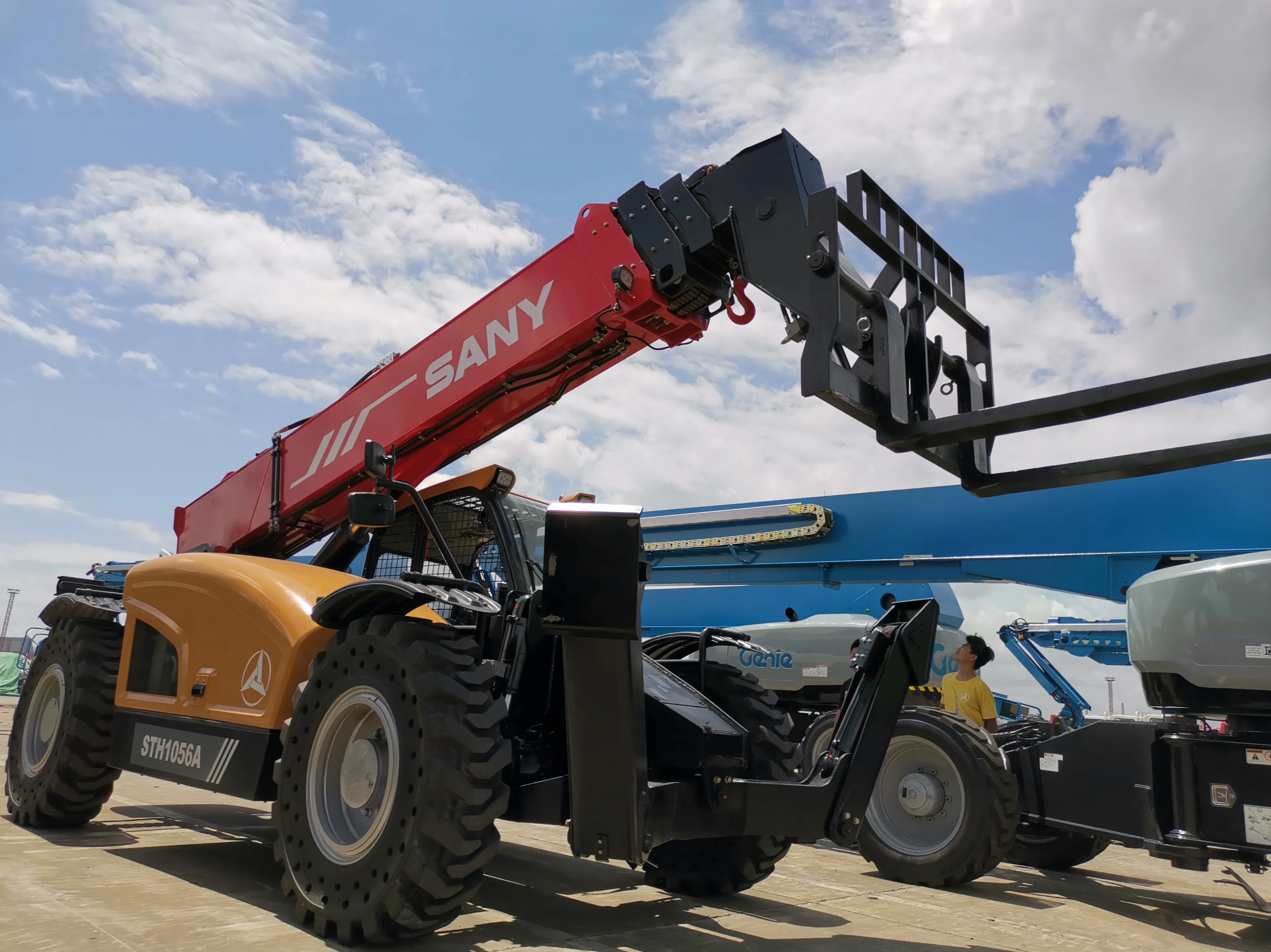
- Low-Reach Type: Lifting height ≤ 6 meters, suitable for low-altitude operations such as warehouses and workshops.
- Mid-Reach Type: Lifting height 6–12 meters, widely used in construction, logistics, and other fields.
- High-Reach Type: Lifting height > 12 meters, used for high-altitude operations such as high-rise building construction and high-bay warehouses.
By Travel Mode
- Wheeled Telehandler: The mainstream type with strong mobility, suitable for most flat and gentle-slope working scenarios. It is divided into two-wheel drive (for flat ground) and four-wheel drive (for complex terrain).
- Tracked Telehandler: Features a large ground contact area and low ground pressure. It is suitable for muddy, soft, and rugged sites such as farmland, mountainous areas, and disaster sites, but has relatively poor mobility and a slower speed.
By Machine Size
- Full-Size Telehandler: Offers a larger working radius and load capacity. However, due to the long working radius, it may be difficult to maneuver and has relatively lower stability.
- Compact Telehandler: Provides enhanced mobility and can accommodate more types of attachments. It is suitable for confined spaces such as indoor operations or crowded construction sites, but only handles lighter loads and has a shorter working range.
By Load Capacity
- Light-Duty: Load capacity ≤ 3 tons, suitable for small cargo handling, agricultural operations, etc.
- Medium-Duty: Load capacity 3–7 tons, a versatile type that meets the needs of most construction and logistics operations.
- Heavy-Duty: Load capacity > 7 tons, used for scenarios such as heavy equipment hoisting and large component handling. It is usually equipped with a powerful engine and reinforced structure to withstand harsh working environments and continuous operation.
Telehandler vs. Other Machines
Telehandler vs. Forklift
- Working Environment: Telehandlers are equipped with four-wheel drive and off-road tires, enabling operation on rough terrain, whereas traditional forklifts are mainly suitable for flat concrete floors or warehouse settings.
- Working Range: Telehandlers can extend both forward and upward, while forklifts typically only lift vertically.
- Versatility: Telehandlers can connect to various attachments such as forks, buckets, platforms, and winches; forklifts are usually limited to fork attachments with fewer options.
Telehandler vs. Skid Steer
- Function: The telescopic boom of a telehandler can reach high and far, designed specifically for high-altitude material handling; the skid steer has a fixed arm and performs better in digging, grading, and tasks requiring high maneuverability.
- Load Capacity: Telehandlers can lift heavier loads to greater heights than skid steers.
- Visibility: Skid steers generally offer better visibility, while the boom of a telehandler may obstruct the operator's view.
Telehandler vs. Crane
- Lifting Capacity & Range: Cranes are engineered for heavier loads and greater heights, with superior lifting capacity and working range compared to telehandlers.
- Mobility: Telehandlers are more compact and offer greater on-site mobility compared to large cranes.
- Cost: For mid-range, high-altitude tasks, telehandlers typically have lower rental and operating costs than cranes.
How to Choose a Telehandler?
It's clear that telescopic boom forklifts have a wide range of applications and diverse functions, and they outperform other equipment in many areas. When choosing a telescopic boom forklift, it's essential to consider your specific operational needs and combine them with the telehandler specifications, taking into account multiple factors to ensure the equipment is suitable for the work environment, efficient, and safe.
Define Load Requirements
It is clear that telehandlers are versatile and widely used, outperforming other equipment in many fields. When selecting a telehandler, you need to base your choice on your specific operational needs and combine them with telehandler specifications, considering multiple factors comprehensively to ensure the machine is suitable, efficient, and safe for the job site.
Adapt to Terrain and Working Environment
Based on the work environment, indoor or warehouse operations are suitable for equipment with smooth, non-marking tires, while outdoor, rough terrain (such as farms and construction sites) requires off-road tires and four-wheel drive models to ensure stability and traction. The size of the workspace should also be considered; compact models with short wheelbases are suitable for confined spaces, while full-size models are better for large areas or heavy-duty applications.
Select Suitable Attachments and Machine Type
Select appropriate attachments based on the task requirements (e.g., forks for pallet handling, buckets for scooping materials, etc.). Prioritize models equipped with quick-connect systems for easy and rapid attachment changes.
Based on the required movement capabilities, choose between a rotating telescopic forklift (suitable for hard-to-reach areas and rough terrain, with 360-degree rotation) or a fixed-boom telescopic forklift (basic model, suitable for conventional material handling).
Consider Size, Maneuverability, and Cost
Equipment size affects maneuverability; smaller, compact models are more agile, while larger models offer greater stability. Budget considerations should include the purchase price, insurance, maintenance, and transportation costs. If a one-time purchase exceeds your budget, consider leasing or buying a used model with a complete maintenance history from a reputable dealer.
Conclusion
How to choose a telehandler? The answer is actually quite simple. Instead of getting bogged down in complex parameter comparisons, the key is to identify your core operational needs. Then, considering load capacity, working terrain, and space limitations, select a suitable model and attachments. By balancing practicality and cost-effectiveness, you can avoid selection pitfalls and ensure the equipment truly meets your needs and performs effectively.
FAQs
What to Look for When Buying a Telehandler?
When purchasing a telehandler, prioritize defining the required maximum load capacity, lifting height, and horizontal reach for the job site. Key considerations include terrain needs (four-wheel drive, outriggers) and ensuring the hydraulic system and boom are functional. For used models, check operating hours, maintenance records, boom, hydraulic/engine/transmission systems, tires, safety devices, and structural integrity. Additionally, choose a reputable manufacturer for ample spare parts and better service.
What are the Common Problems with Telehandlers?
Common telehandler issues include safety hazards and mechanical failures. Safety risks involve boom overloading and overturning from unstable terrain, while mechanical problems include hydraulic leaks, brake failures, and engine overheating. These issues often stem from operator errors such as poor visibility, blind spots, and improper attachment use. Thus, proper operator and safety training are essential.
What is the Life Expectancy of a Telehandler?
A well-maintained telehandler typically lasts 8,000–12,000 operating hours before major overhauls; high-quality models can exceed 20,000 hours with proper care. Assuming 5 days/week, 8 hours/day operation (≈2,000 hours/year), its average lifespan is 4–10 years, depending on usage intensity and maintenance.
Featured Products
Recommend Blogs
What Is a Mini Telehandler: Practical Selection and Rental Guide 2026
This article introduces the definition, applicable scenarios, and selection guidelines for mini telehandlers, helping you construct efficiently.
What Is a Telehandler? Key Functions, Principles & Application Scenarios
This article explains what a telehandler is, outlining its components, functions, uses, and types. It also compares telehandlers with forklifts and cranes to help you choose the right equipment.
What Is a Telehandler? How It Works and Why It’s a Must-Have Machine
Learn what a telehandler is, how it works, and how to choose the right model for your job in this practical, easy-to-follow guide.