Core Difference Table for Front End Loader vs Bulldozer and Practical Project Selection Methods
This article will conduct a comprehensive analysis of front end loader vs bulldozer from the perspectives of definition, structure, applications, and selection strategies.
In material transfer on construction sites, earthwork consolidation in mining areas, and site leveling for agricultural reclamation, front-end loaders and bulldozers are always "engineering partners" that appear frequently. However, many people are confused: since both handle earthwork and materials, what is the difference between them? When should a loader be chosen, and when should a bulldozer be used? How to match them with project needs? Today, we will analyze front end loader vs bulldozer in detail to help you fully clarify the "division of labor and adaptation logic" of these two types of heavy machinery.
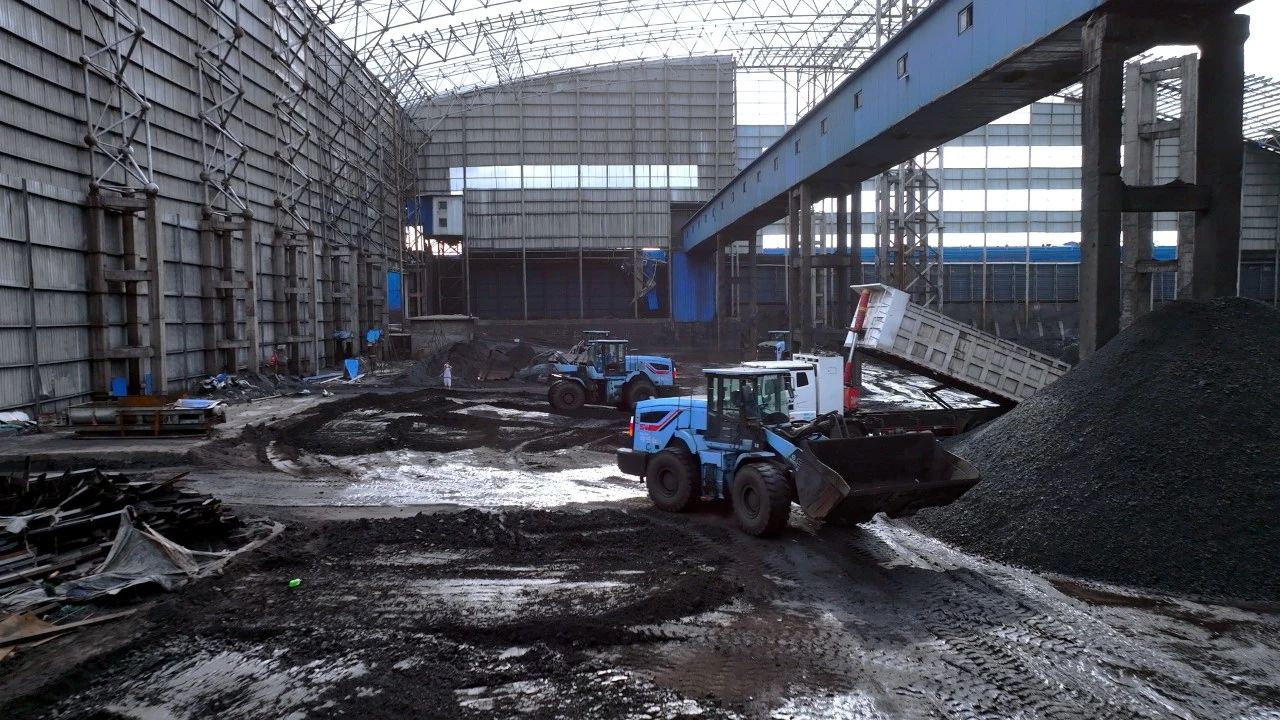
What Is a Front End Loader?
The front-end loader takes "flexible loading and short-distance handling" as its core advantages, and it is an efficient piece of equipment for handling loose materials.
1.Core Definition
A front-end loader is a type of heavy machinery equipped with a liftable and tiltable bucket at the front of its body. It is mainly used for loading and handling loose materials such as soil, sand, and coal. Its maximum operating transport distance usually does not exceed 1 kilometer, and it is suitable for operations across multiple work surfaces.
2. Key Structural Components
Its structure is designed around "efficient operation" and "flexible movement", with core components including:
- Working Mechanism: Composed of a bucket, boom, connecting rod, and hydraulic cylinder. Some models can be equipped with replaceable attachments such as log grapples and breakers.
- Travel Chassis: Mainly tire-type, with a small ground contact area, flexible in movement and has a small turning radius, suitable for driving on hard ground. A small number of models use crawler-type chassis for special scenarios to adapt to soft roads.
- Power and Control System: Equipped with a medium-power diesel engine, matched with a hydraulic control system. The bucket and boom movements are precisely controlled via control levers. The cab is located at a relatively high position for easy observation of the work surface.
3.Main Classifications
Front-end loaders can be classified based on application, bucket capacity, and travel mode:
- By Application:
Engineering Type (with a lightweight structure, used in construction and municipal engineering)
Mining Type (with a reinforced structure, wear-resistant, used in mines)
- By Bucket Capacity:
Small Size (≤5 cubic meters, suitable for small-scale projects)
Medium Size (5-10 cubic meters, universal type)
Large Size (>10 cubic meters, used in large-scale mines)
- By Travel Mode:
Tire-Type (most widely used, with fast movement speed)
Crawler-Type (adapts to muddy terrain)
4.Core Applications
All applications of front-end loaders revolve around "loading + handling", with specific scenarios including:
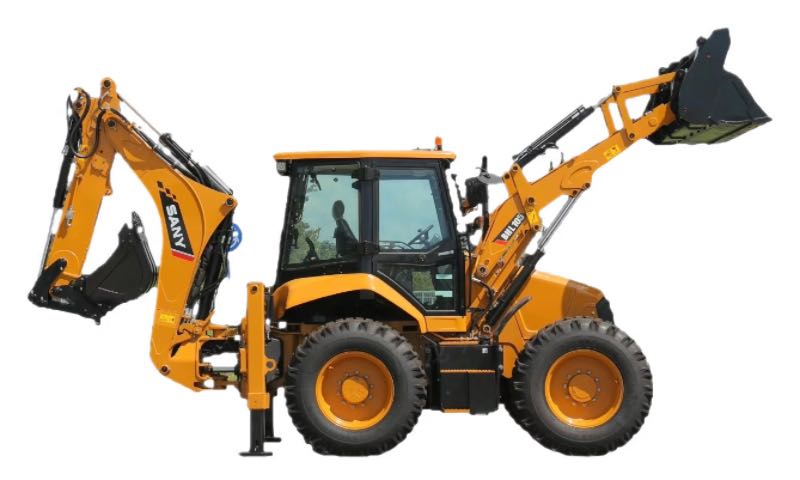
- Construction and Municipal Engineering: Handling building materials such as cement and sand, cleaning construction waste, and coordinating with backhoe loaderfor earthwork transfer.
- Mining and Quarrying: Loading ores and gravel, loading them into mining trucks, and transporting to crushing workshops or mineral processing plants.
- Agriculture and Animal Husbandry: Handling straw, feed, and grain, cleaning manure in farms, and leveling farmland sites.
- Logistics and Warehousing: Loading and unloading bulk goods in ports and warehouses, and capable of handling containers when matched with special attachments.
What Is a Bulldozer?
The bulldozer takes "strong traction and stable leveling" as its core advantages, and it is a key equipment for handling basic earthwork operations.
1.Core Definition
A bulldozer is a type of heavy machinery equipped with a fixed dozer blade at the front of its body, mainly using crawler-type chassis. It is primarily used for earth pushing, site leveling, and obstacle removal. Its operating distance is usually within 100 meters, and adapted to complex and rough terrain.
2.Key Structural Components
Its structure is designed around "stable earth pushing" and "adaptation to harsh terrain", with core components including:
- Working Mechanism: The front end is equipped with a fixed dozer blade, which can be adjusted in angle but cannot be reversed, and its lifting is controlled by hydraulic cylinders. Some large-sized models are equipped with a ripper at the rear, which is used for breaking hard soil layers and small rocks.
- Travel Chassis: All models adopt a crawler-type design, which has a large ground contact area and strong adhesion. It can drive stably on muddy and rough roads, avoiding slipping or getting stuck.
- Power and Control System: Equipped with a high-power diesel engine to provide strong traction. The control system controls the movement of the dozer blade and crawler travel through mechanical or hydraulic transmission. The cab is located at a relatively low position, close to the ground to match the visual field required for earth pushing.
3.Main Classifications
Bulldozers can be classified based on function and applicable scenarios:
- General-Purpose Type: With a compact and flexible body and a moderately wide dozer blade, it is used for construction site cleaning, small-scale earthwork projects, and agricultural land reclamation.
- Special-Purpose Type:
Mining-Specific Type with a reinforced structure, large-capacity dozer blade, and wear resistance.
Wetland-Specific Type with wider crawlers and low ground pressure, suitable for marsh terrain.
4.Core Applications
All applications of bulldozers revolve around "leveling + pushing", with specific scenarios including:
- Construction and Municipal Engineering: Leveling construction foundations, flattening road subgrades, and cleaning up debris on construction sites.
- Mining and Quarrying: Leveling the ground in mine mining areas, building temporary transportation roads, cleaning up slag, and organizing ore piles.
- Agriculture and Water Conservancy: Reclaiming wasteland, leveling farmland, digging small irrigation ditches, and building field ridges.
- Emergency Rescue: Leveling collapsed ruins at earthquake and flood sites, opening up rescue channels, and building temporary flood control dikes.
Bulldozer vs Front Loader: Key Differences
Comparison Category | Front End Loader | Bulldozer |
Core Function Positioning | Focuses on "loading + handling", with the core of flexibly handling loose materials | Focuses on "leveling + pushing", with the core of handling earthwork operations through strong traction |
Main Functional Performance |
|
|
Working Device Design |
|
|
Travel Chassis Type | Mainly wheel loaders, with a small number of crawler excavators and skid steer loaders. | All models adopt crawler-type; no tire-type design |
Cab Design | Located at a high position, facilitating observation of the bucket operation surface with a wide field of view coverage | Located at a low position, close to the ground, adapting to the visual needs of earth pushing operations and focusing on front ground observation |
Size Characteristics |
|
|
Mobility Performance |
|
|
Traction Level | Medium, only meeting the needs of short-distance movement after loading materials, unable to resist high-intensity resistance (e.g., hard soil pushing) | Extremely strong; crawlers have high adhesion, capable of easily pushing large amounts of earthwork or breaking hard soil layers, with strong resistance resistance |
Power Configuration | Mainly medium power; large mining models have higher power (adapting to heavy-load loading) | Generally high-power configuration (supporting strong traction needs); mining-specific models have even higher power |
Operation Speed | 15-30 km/h, flexible for short-distance round trips, with fast response of loading actions | 5-15 km/h, stable and powerful earth pushing actions, slow driving speed |
Fuel Efficiency |
|
|
Terrain Adaptability | Suitable for flat and hard sites (e.g., concrete ground, compacted earth roads, inside workshops), and can operate in narrow spaces | Suitable for rough and soft sites (e.g., muddy construction sites, mine mining areas, wetlands), and performs better in open spaces |
Operation Distance Adaptation | Adapted to short-distance handling (≤1 km); efficiency decreases significantly beyond 1 km | Adapted to ultra-short-distance earth pushing (≤100 meters); pushing efficiency decreases significantly beyond 100 meters |
How to Choose Between a Front End Loader vs Bulldozer for Your Project
To select a front end loader or bulldozer, it is necessary to make judgments step by step from the three dimensions of "operation requirements, site conditions, and efficiency & cost", and combine the technical characteristics and product matrix of equipment manufacturers to achieve accurate adaptation. As a global mining equipment manufacturer, SANY loader and supporting equipment system can provide mature solutions for different scenarios:
Step 1: Clarify the Core Operation Type
- Priority Selection: Front End Loader
When the operation focuses on "loading + handling" or requires flexible switching between multiple scenarios, the front end loader should be the priority. SANY wheel loader series covers a wide range of scenarios and offers a variety of models, which can accurately match material handling needs of different scales and provide reliable guarantee for operation efficiency.
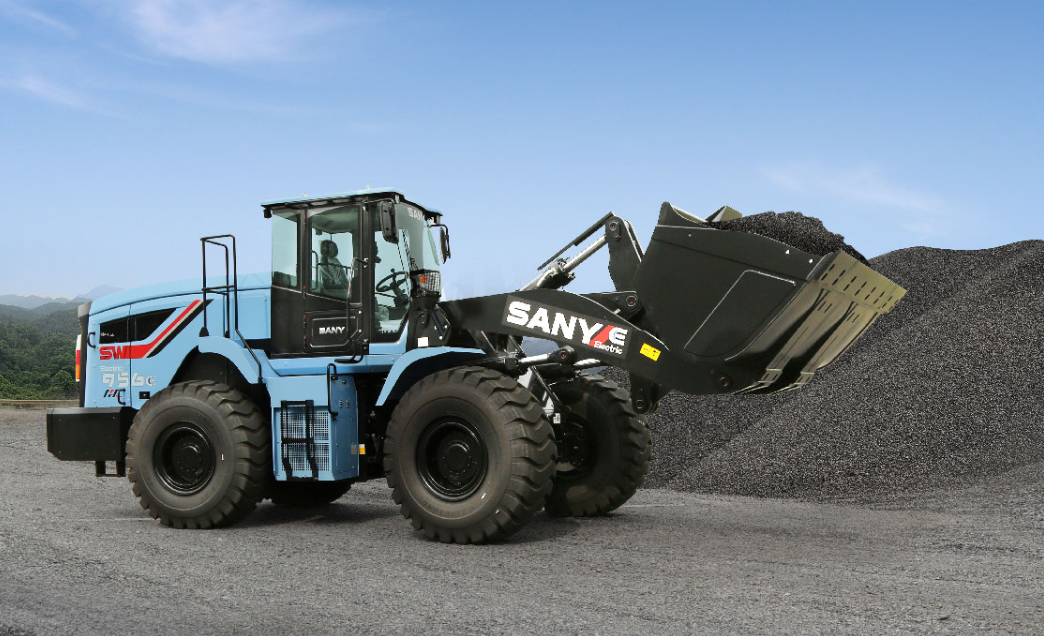
For scenarios demanding high environmental standards—including urban construction and logistics warehousing—SANY Pure Electric Loader SW956E is an ideal choice, as it perfectly adapts to the safe operation requirements of narrow workspaces.
- Priority Selection: Bulldozer
When the operation focuses on "leveling + pushing" or requires working in complex terrain, the bulldozer should be the priority. For needs such as mine site leveling and hard soil breaking, SANY dedicated equipment can be matched to form a combined solution:Use SANY crawler bulldozer to complete earth pushing and initial site leveling.In case of hard geology such as strongly weathered rock formations, it can work in coordination with SANY SH Series hydraulic grab buckets, which can efficiently break hard soil layers and clean up waste residue.

- Mixed Operation Scenarios
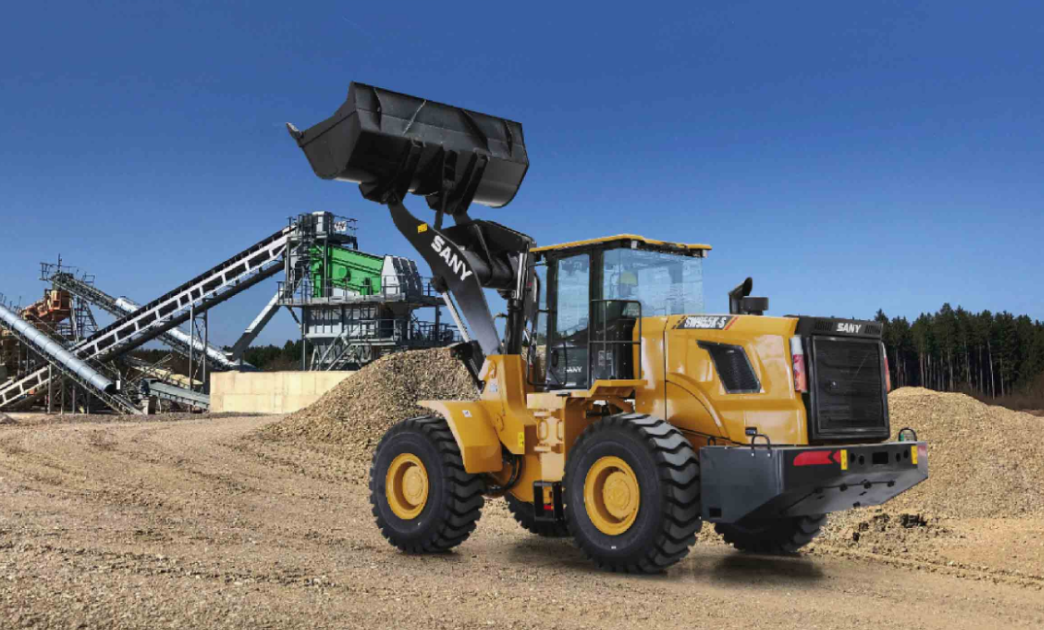
When leveling operations account for more than 70% of the total work, supplemented by a small amount of material handling, a combination of "bulldozer + small loader" can be adopted. For example, in construction projects:Use a bulldozer to level the foundation.Match with SANY SW series loader to transfer sand and gravel building materials. Its flexible steering system and driving speed enable quick switching between multiple operation points.
Step 2: Evaluate Site Conditions
Terrain and Ground Hardness Adaptation
- Flat and Hard Ground: Choose a wheel loader. Its tire chassis has low wear when driving on hard ground. In addition, some of SANY models are equipped with keyless start and TFT LCD screens, which can simplify fleet management and equipment monitoring.
- Soft and Rough Ground: Rely on the strong adhesion of crawler-type equipment. You can select SANY crawler equipment with wetland-specific configuration. Combined with its working device with a fully sealed slewing bearing structure, it ensures operation accuracy and equipment service life in muddy environments.
Operation Space Adaptation
- Narrow Space: Prioritize small loaders. Their compact body design and small turning radius allow flexible operation in limited spaces.
- Open Space: Large equipment combinations can be used, such as a loader matched with a crawler bulldozer. The former is responsible for material loading and transportation, while the latter is responsible for site organization. The operation scheduling can be optimized through an intelligent management system.
- Handling Distance: Choose a loader for distances ≤1 km (high efficiency); choose a bulldozer for distances ≤100 meters (low cost).
Step 3: Calculate Efficiency and Cost
- Operation Efficiency: For loading and handling, choose a loader (high cargo loading volume per unit time); for leveling, choose a bulldozer (large leveling area per unit time).
- Comprehensive Cost: In terms of purchase cost, loaders of the same tonnage are cheaper; in terms of operating cost, bulldozers have higher fuel consumption and faster crawler wear.
- Flexibility: If new operation types (such as grabbing, breaking) need to be added later, choose a loader; if the operation is fixed, choose a bulldozer (high durability).
Conclusion
Whether it is the flexibility and efficiency of the front end loader or the stability and power of the bulldozer, both are indispensable and important equipment in engineering construction. In fact, there is no absolute advantage or disadvantage between front end loader vs bulldozer—only a difference in adaptation. It is hoped that the analysis and suggestions in this article can provide clear references for engineering practitioners, helping them quickly find the most suitable "engineering tool" amid complex project requirements and promote the efficient and smooth progress of projects.
FAQs
What Are the Disadvantages of a Front-End Loader?
A front-end loader has three core disadvantages:
- Insufficient Flexibility and Precision: It has a wide body and a fixed wheelbase, making it difficult to turn in narrow spaces. Additionally, the bucket operation cannot complete fine tasks.
- Limitations in Scenarios and Terrain: Its heavy body is prone to getting stuck on soft ground. Moreover, the lifting height and digging depth of the bucket are limited, so it cannot handle deep pit operations or high-altitude operations.
- High Comprehensive Costs: The purchase price and maintenance costs of core components such as the hydraulic system and gearbox are high. Meanwhile, the high-power diesel engine leads to high fuel consumption and operating costs.
What Are the Three Types of Bulldozers?
Bulldozers are mainly divided into three types: crawler-type, wheel-type, and special-purpose type.
- Crawler-Type Bulldozers: They have strong adhesion, are suitable for muddy and rough terrain, and ensure stable operation. However, they have slow speed and low steering flexibility.
- Wheel-Type Bulldozers: They have fast driving speed and convenient transfer, making them suitable for flat and hard ground. Yet, they are prone to slipping and have weak load-bearing capacity.
- Special-Purpose Bulldozers: Designed for specific scenarios. For example, wetland bulldozers are equipped with wide crawlers to prevent getting stuck, and blasting bulldozers have protective devices. They have strong functional targeting but a narrow scope of application.
Can a Front-End Loader Replace a Bulldozer on Small Projects?
In small projects, a front-end loader can replace a bulldozer in some scenarios, but it cannot completely replace it.
If the project mainly involves material loading and short-distance handling (such as sand loading/unloading and site leveling), a front-end loader can be competent.
However, when facing the core operations of a bulldozer—such as deep earth pushing, foundation excavation for sites, and removal of tree roots and weeds—the front-end loader has insufficient bucket angle and thrust, resulting in low efficiency.
Furthermore, the crawler design of a bulldozer is more suitable for soft ground, while a front-end loader is prone to getting stuck.
Featured Products
Recommend Blogs
What Is a Skid Loader? Meaning, Principle & Guide
This article provides a detailed analysis of what is a skid loader is, including its core components, working principle and application scenarios. It also compares different loaders and offer a practical selection guide.

What Is a Wheel Loader? A Practical Overview for 2025
This article explains what is a wheel loader, its working principle, applications, key components, types, sizes, and how to choose the right model to help project managers improve efficiency.
What Is a Skid Steer Loader: A Comprehensive Guide to Sizes, Uses, and Selection
What is a skid steer loader? With skid steering and quick attachment changes, it boosts efficiency and cuts costs. This guide offers an in-depth analysis with practical tips.