Backhoe vs. Excavator: Your 2025 Heavy-Equipment Buying Guide
This article introduces the differences between backhoe vs. excavator, their respective advantages, and how to choose the right heavy equipment to help work crews perform better.
In construction, landscaping, and agricultural production scenarios, heavy equipment such as excavators and backhoe loaders has always been the core force for boosting efficiency and tackling complex tasks. So, what are the differences between backhoe vs. excavator? What are their respective advantages? How can you find the equipment that matches your own operational needs? This article will address each of these questions one by one, helping every operator choose the right equipment and use it well, making the path of construction smoother and more efficient.
What Is an Excavator and What Is a Backhoe?
Choosing the right equipment not only gives your project a significant boost but also maximizes the value and lifespan of the machinery over long-term use. Understanding the definitions of excavator vs. backhoe helps you select the right machine.
What is an excavator?
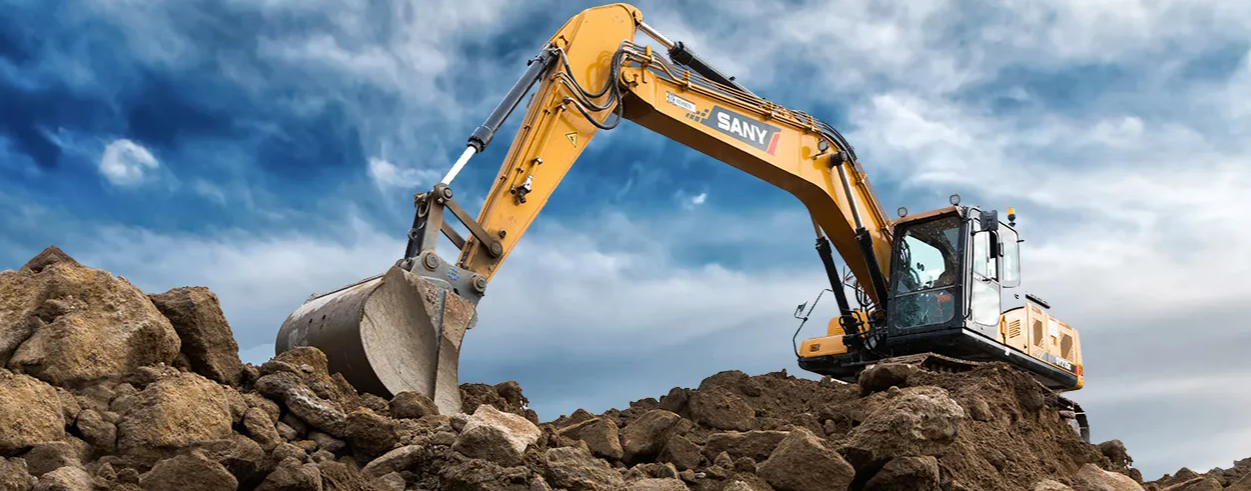
An excavator is a versatile piece of heavy construction machinery—also known as a digging machine or backhoe—and is composed of three main components: the undercarriage, the cab, and the boom with dipper arm. Its most distinctive feature is 360° continuous rotation capability, allowing the hydraulic system to drive the bucket for digging, loading, dumping, breaking, lifting, piling, mining, dredging, and other operations.
What is a backhoe?
A backhoe generally refers to a backhoe loader or backhoe digger. It is a small, multifunctional machine combining a loader bucket at the front with a backhoe digging arm at the rear. It’s mainly used in landscaping, construction, and agricultural renovation tasks—such as tree planting, ground excavation, hauling soil or construction debris, and even breaking pavement.
Key Differences Between Excavator and Backhoe
Although an excavator and a backhoe can perform similar tasks, there are significant differences. Clarifying these distinctions helps you choose the right machine for your project and operate it correctly, ensuring both equipment longevity and productivity. The main differences between a backhoe loader and an excavator center on three aspects: size and design, multifunctional attachments, and swing range.
Size, Specifications, and Design
Excavators: Generally larger and heavier, excavators are categorized as mini, small, medium, and large, each suited to different work environments.
- Mini Excavators: Weighing under 6,000lb, ideal for tight spaces, complex sites, and precision work.
- Small Excavators: Weighing between 8,000lb and 30,000lb, these machines are nimble in confined areas and perfect for narrow jobs.
- Medium Excavators: Weighing 30,000lb to 70,000lb—most commonly 40,000–50,000lb—these models handle nearly every application, from municipal earthworks and road building to mining and land clearing.
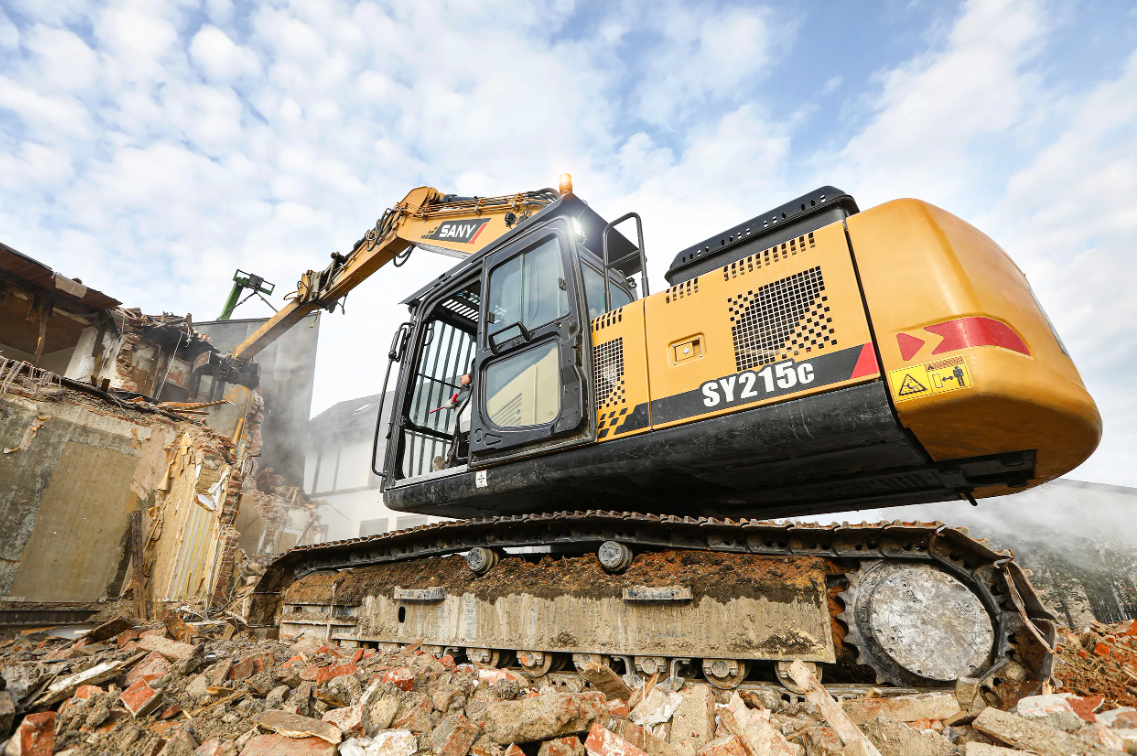
For example, SANY’s medium excavator series has earned the trust of many construction teams. In particular, the 20–21.5 T Medium Excavator, with its advantages of economical, big digging force, easy to operate, and high efficiency, is highly trusted by doer of earthmoving. Its engine delivers 104–125 kW of power, the bucket capacity ranges from 0.83 to 1.2 m³, and its operating weight spans 40,000–48,000lbs, giving it an exceptionally broad working range.
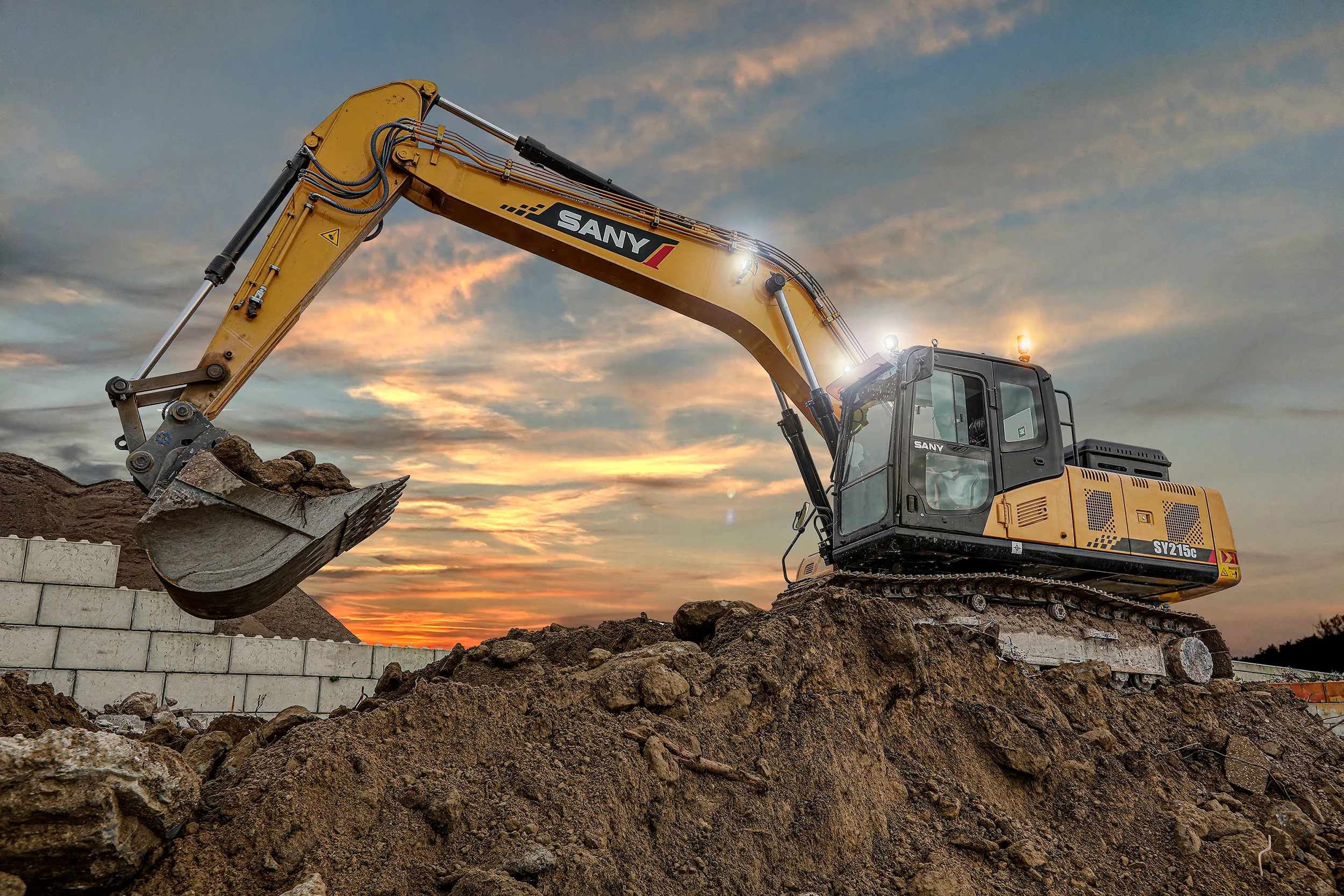
- Large excavators: Weigh over 70,000lb, suited for heavy commercial construction or demolition projects.
Backhoe loaders: Notable for their compact, streamlined design, weighing approximately 6,600lb to over 44,000 lb. Its smaller footprint makes it easy to maneuver in confined sites and small job locations, and it’s well-suited for loading, agricultural tasks, snow removal, and similar medium-scale projects.
Main Attachments
Besides size and design differences, the work scenarios for an excavator and backhoe dictate distinct attachment options.
- Excavator attachments include buckets, hydraulic thumbs, augers, breakers, rippers, and quick-couplers.
- Backhoe loader attachments include augers, trenchers, breakers, compactors, crushers, hammers, log grapples, pallet forks, trenching buckets, snow blades and plows, specialty buckets, street sweepers, stump grinders, tampers, thumb buckets, and tooth adapters, among many others.
Swing Range
- Excavators feature 360° rotation, allowing work in any direction without repositioning the entire machine.
- Backhoe loaders use a dual-function design—with a digging arm at the rear and a loader bucket at the front—offering a swing range of around 200°.
Functions
- Excavator functions: Mining, demolition, material lifting, material handling, and large-scale construction.
- Backhoe loader functions: Digging, landscaping, material loading, agricultural work, material handling, small-scale demolition, and light construction.
Advantages and Limitations of Excavator vs. Backhoe
Excavator Advantages and Limitations
Advantages
- High work capacity: Standard models are large and heavy with powerful engines, suitable for heavy attachments like breakers and lifts.
- Flexible operation: 360° rotation boosts efficiency by allowing all-around work without moving the chassis.
- Wide application: Available in heavy models for large earthworks and mining, as well as compact models for tight-space operations.
Limitations
- Transport difficulty: Large models require specialized transport vehicles, increasing cost and time.
- High skill threshold: Complex operation demands professional training.
- Site constraints: Large machines can’t maneuver well in small or confined areas and may damage the site.
Backhoe Loader Advantages and Limitations
Advantages
- Site adaptability: Compact size allows easy movement in narrow or small-scale job sites.
- Versatility: Dual-function design lets operators switch quickly between digging and loading.
- Ease of operation: Simpler controls lower the skill barrier and shorten training time.
Limitations
- Limited swing: 200° rotation reduces efficiency for large-range work.
- Lower digging capacity: Smaller size and lighter weight limit depth and force compared to excavators.
- Reduced stability: Less capacity for heavy loads or complex tasks, risking tipping or uneven handling.
How to Choose Between a Backhoe and an Excavator?
Based on Project Scale
- Large projects (such as mining and major earthmoving): Prioritize an excavator, as its strong power and high production capacity can efficiently complete heavy tasks.
- Small to medium projects (such as farmland renovation and minor infrastructure maintenance): A backhoe is more suitable, whose compact form can meet basic operational needs.
By Site Conditions
- Open sites: An excavator’s 360° rotation advantage is significant, allowing all-around operation without frequent repositioning.
- Tight spaces or complex terrain: A backhoe’s compact size is more agile, enabling smooth maneuvering in constrained environments.
By Functional Requirements
- Single digging needs: An excavator is more specialized and compatible with heavy attachments such as breakers and lifting gear.
- Multi-task switching needs: A backhoe’s dual-function design (boom + loader bucket) is more practical, enabling quick mode switching.
Considering Operation and Cost Factors
- Operating threshold: A backhoe is easy to operate, suitable for novices or short-term work; an excavator requires professional training, ideal for long-term professional use.
- Transport cost: A backhoe’s small size makes relocation convenient and low-cost; a large excavator requires specialized transport, increasing time and expense.
Combined with work intensity
- High-intensity, deep excavation: Choose an excavator, as it offers superior digging force and depth.
- Routine shallow excavation: A backhoe offers a higher cost-performance ratio, meeting basic digging needs.
Conclusion
In summary, the differences between backhoe vs. excavator are clearly visible. By grasping these distinctions and considering factors such as project scale, site conditions, and specific requirements, you can select the right equipment, not only improving construction efficiency but also extending equipment lifespan, ensuring that every project advances efficiently.
FAQs
Can a backhoe replace an excavator for large projects?
On large-scale projects, a backhoe loader generally cannot replace an excavator. A backhoe is agile but has limited digging depth, force, and stability, and its 200° swing restricts efficiency. Large projects require high-intensity work, full-range rotation, and heavy-duty attachments.
Is 360° rotation crucial in tight job sites?
In confined construction sites, 360° rotation is vital. It lets the equipment work in all directions without repositioning, minimizing site footprint. Especially where space is limited, full rotation enhances flexibility and safety, avoiding efficiency loss or collisions due to restricted swing.
Which machine offers better ROI for farm use?
For farm applications, a mid-sized excavator typically offers the best return on investment. Weighing between 12,000lb and 60,000lb, it handles tasks such as digging irrigation channels, clearing land, and moving heavy loads more effectively than a backhoe loader.
Featured Products


Recommend Blogs
How to Operate a Mini Excavator: A Beginner’s Step by Step Safety Guide
This guide systematically breaks down the essential knowledge of how to operate a mini excavator, helping you work safely and complete tasks efficiently
Excavator vs Bulldozer: Functions, Key Differences and How to Choose
Not sure whether excavator vs bulldozer is the right choice? This article explains both machines’ functions, differences, and selection methods to help you pick the best equipment for 2025 construction projects
What Is an Excavator? How to Choose the Right Model for Your Project Needs
Discover what an excavator is and how to choose the ideal model—from compact mini machines to powerful large excavators—for your project’s size, terrain, and productivity needs