Reach Stacker: 2025 Complete Guide to Selection and Application
This article introduces the definition, features, types and application scenarios of reach stackers, helping project managers better empower their business operations.
Efficient handling of containers and heavy-duty cargo at global ports, freight yards, and intermodal hubs is crucial for logistics turnover speed. Meanwhile, as a versatile heavy-duty equipment, the reach stacker is transforming revolutionizing traditional handling modes with its powerful performance. From reducing loading and unloading times to optimizing warehouse space, and from improving safety standards to cutting operational costs, it has become an indispensable core asset in modern logistics. This article will provide a comprehensive breakdown of the reach stacker’s definition, features, types, and application scenarios, helping you understand its differences from traditional equipment, as well as how to empower your operations.
_100812.png)
What Is a Reach Stacker?
1.Definition of Reach Stacker
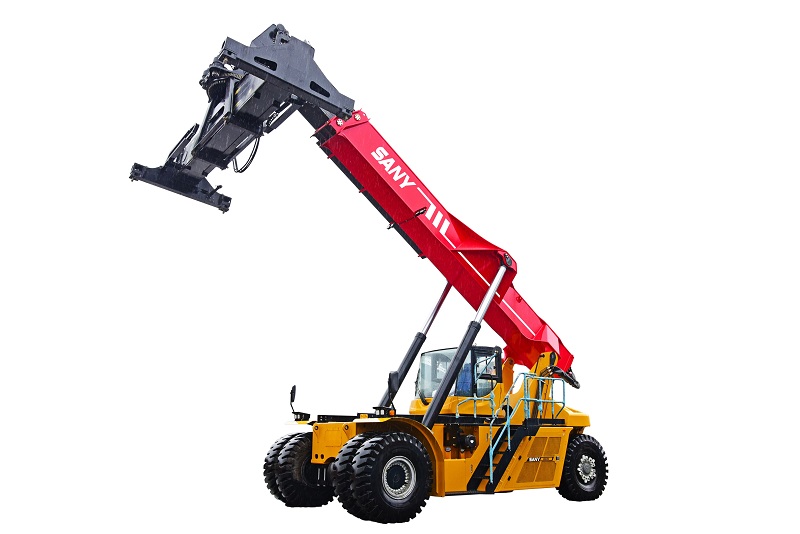
A reach stacker, short for container front crane, is mobile lifting equipment used for loading, unloading, and horizontal transportation of containers. Hence, it is also known as a container reach stacker or reach stacker forklift. Featuring "efficient stacking + flexible handling", it can safely handle multi-sized containers in both narrow spaces and open areas, with a lifting capacity of over 45 tons.
Different from traditional handling equipment, the reach stacker combines the dual advantages of "high lifting height" and "high-precision maneuverability". It can stack containers to maximize the use of vertical storage space and adapt to operations in crowded areas through flexible steering, completely solving the industry pain points such as "difficult handling, difficult stacking, and low space utilization". Whether independently completing container loading and unloading, or connecting the intermodal transportation links of trucks and railway wagons, the reach stacker can achieve one-stop handling, making it an "all-round player" in heavy-duty logistics scenarios.
2. Working Principle of Reach Stacker
Reach stackers mainly drive the hydraulic system through diesel engines or electric power to provide power for boom extension/retraction, luffing, and spreader movements. Operators control various actuators from the elevating cab, and with the rotatable and laterally movable dedicated spreader, they realize the grabbing, transporting, and multi-layer stacking of containers. The core of the system lies in hydraulic transmission and precise torque control, ensuring efficient, stable, and safe operations.
- Hydraulic Power System
Diesel engines or electric power drive hydraulic pumps to generate high-pressure oil, which is controlled by precision valve blocks to provide power for all actions, such as boom extension/retraction and luffing. Spreader lifting/lowering is not achieved by direct lifting, but by controlling the boom luffing angle, resulting in a larger operating range and higher flexibility.
- Front-and-Rear Balance
The load moment limiter is the core safety device for maintaining balance. It monitors boom length, angle, and load weight, and automatically calculates the overturning moment for the entire machine.
- Oil Supply and Pressure Control
Hydraulic pumps and valve blocks work in sophisticated synergy. The hydraulic pump draws oil from the tank and generates pressurized oil. According to operational needs, the multi-way directional valve controls the oil flow direction and flow rate to realize the start, stop, and speed adjustment of different actions. The relief valve acts as a "safety valve" for the system, ensuring pressure is always within a safe range.
- Fault Diagnosis
Operators and maintenance personnel usually conduct comprehensive analysis by observing for leaks, listening for abnormal noises, monitoring instrument alarm, and assessing movement smoothness to quickly locate problems.
Core Features of Reach Stacker
The core competitiveness of reach stackers stems from four key features that precisely meet the logistics industry’s needs: heavy load, high efficiency, flexibility, and safety:
1.Superior Heavy-Load and Stacking Capacity
Reach stackers can easily handle containers of different specifications and heavy cargo. Their vertical stacking capability significantly improves warehouse space utilization.
2.High-Precision Maneuverability
Equipped with an all-wheel steering system and a compact body design, reach stackers have a small turning radius, allowing them to move flexibly in container-dense freight yards or narrow storage areas without requiring large operating spaces.
3.Flexibility for Multi-Scenario
Reach stackers are not limited to container handling. They can also load and unload trucks and railway wagons by replacing attachments, as well as handle non-container cargo such as steel and large equipment, This allows adaptation to intermodal transportation and cross-scenario operations.
4.Comprehensive Safety Assurance
Reach stackers are equipped with advanced technologies such as intelligent stabilization systems, anti-overturning devices, and load-sensing alarms to monitor operating status in real time. When risks arise due to excessive load or uneven ground, the equipment automatically issues warnings and restrict operations, maximizing the safety of operators and cargo.
Types of Reach Stackers
Based on power sources, operating scenarios, and load capacity, reach stackers can be divided into the following 4 categories, each adapting to different logistics needs:
1.Diesel-Powered Reach Stackers
The mainstream type, featuring powerful performance and unlimited endurance. Suitable for outdoor heavy-duty scenarios such as ports and open-air freight yards, enabling all-weather operations.
2.Electric Reach Stackers
Environmentally friendly and energy-efficient, with low noise and zero emissions. Suitable for indoor freight yards, urban warehousing centers, or areas with environmental requirements, requiring supporting charging facilities.
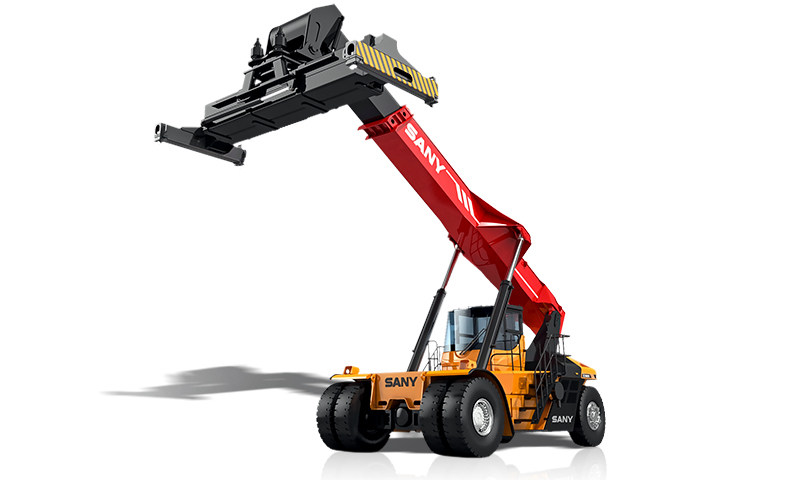
For example, the SANY reach stacker has been widely adopoted by operations teams, especially the 35T reach stacker SRSC3532H1-L , which demonstrates exceptional performance. With a rated lifting capacity of 35 tons, it meets the needs of various indoor and outdoor handling scenarios. Equipped with a large-capacity lithium battery and fast charging support, it effectively improves operational efficiency. Coupled with an intelligent electronic control system, its operation is extremely precise and stable, making it adaptable to complex logistics operations, making it an excellent choice for users who pursue environmental protection and operational efficiency.
3.Hybrid-Powered Reach Stackers
Combine the advantages of diesel and electric power: uses electric power during low-speed operations to save energy, and switch to diesel power for heavy loads or long distances. Suitable for logistics hubs with multi-scenario operations, balancing environmental protection and practicality.
4.Heavy-Duty Specialized
Reach Stackers are designed for oversized containers or special cargo, with a lifting capacity of over 45 tons. Equipped with reinforced booms and stabilization systems, they are ideal for maritime logistics and heavy industrial scenarios.
What Is the Difference Between a Reach Stacker Forklift, a Traditional Forklift, and a Reach Truck?
The main differences between a reach stacker forklift, traditional forklifts, and reach trucks lie in their design and functionality, mobility, and applicable scenarios. A reach stacker is a large lifting device, often used for loading and unloading containers. Traditional forklifts are versatile, suitable for various terrains and cargo handling, but require more operating space. Reach trucks are specifically designed for narrow aisles, with fork extension functions to achieve high-level stacking and optimize warehouse space utilization.
Reach Stacker Forklift
- Design and Functionality: Large-scale heavy-duty lifting equipment capable of lifting and moving heavy cargo such as containers, mainly used in scenarios like ports, terminals, and large warehouses.
- Mobility: Relatively limited mobility, not suitable for internal operations in ordinary warehouses.
- Applicable Scenarios: Primarily used for heavy-duty operations such as loading, unloading, and handling of containers.
Traditional Forklift
- Design and Functionality: Features a counterbalanced design with a low center of gravity and strong load-carrying capacity, applicable in indoor and outdoor mixed environments.
- Mobility: Good mobility but requires a larger operating space.
- Applicable Scenarios: Suitable for handling various types of cargo, as well as short-distance transportation and stacking operations on flat ground, making it the most widely used type of forklift.
Reach Truck
- Design and Functionality: Its most notable feature is that the forks can extend forward, with outriggers stabilizing the body. It has a compact structure, making it suitable for operations in narrow aisles.
- Mobility: More flexible than traditional forklifts, able to move effectively in narrow warehouse aisles.
- Applicable Scenarios: Mainly used in high-rack warehouses, achieving high-level stacking and precise picking/placing of goods through fork extension, maximizing the storage utilization.
Typical Applications of Reach Stackers Across Industries
As engineering machinery designed for handling heavy-duty cargo and containers, reach stackers, with their "heavy-load + flexibility" attributes, span multiple industries and serve as "efficiency accelerators" in various scenarios. They are mainly applied in ports, terminals, freight yards, warehousing centers, and intermodal hubs. Their typical applications include:
1.Ports/Terminals
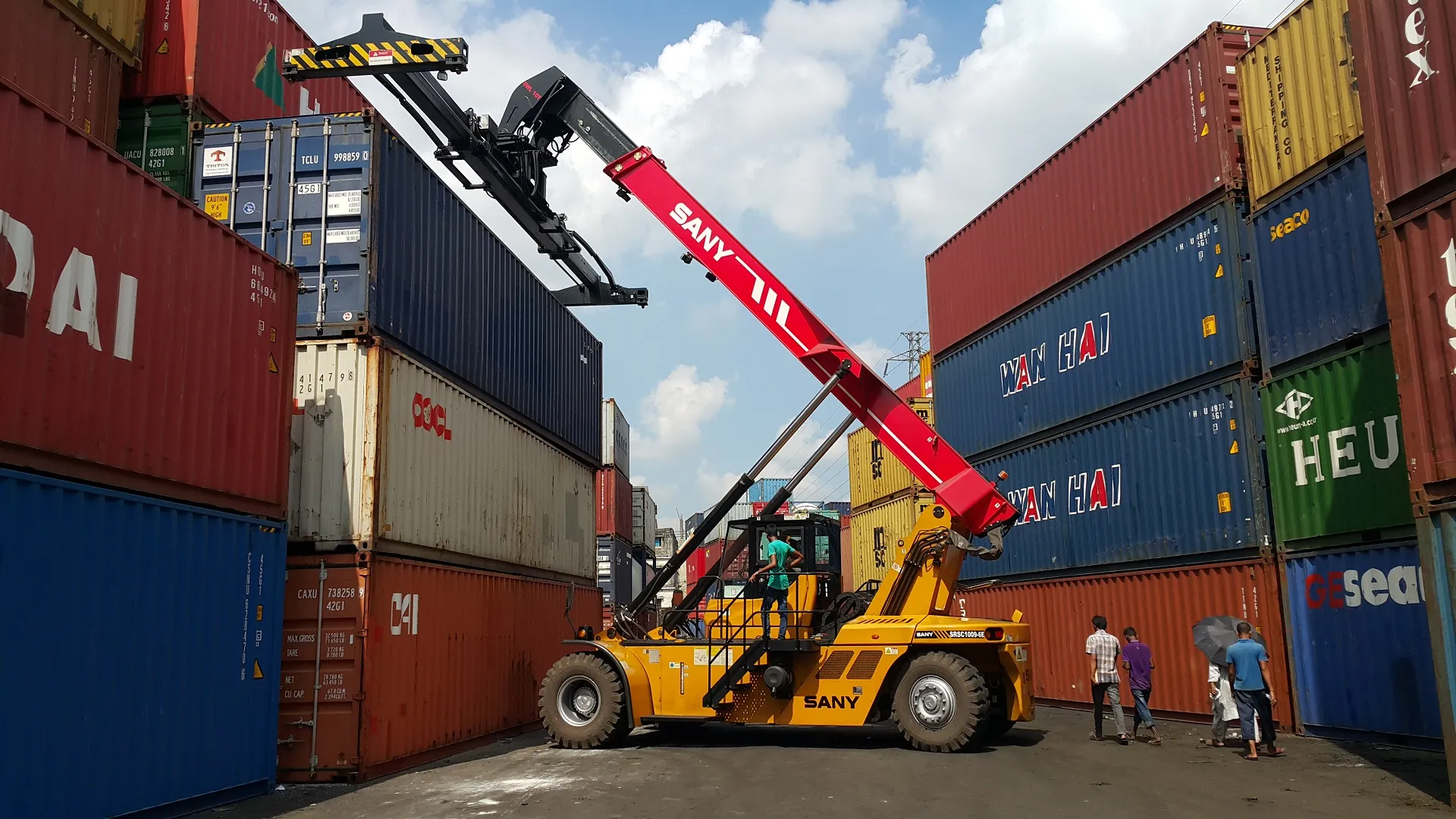
As a core application scenario, reach stackers are responsible for loading/unloading container ships, stacking in yards, and transferring goods. They significantly reduce the loading/unloading time that traditionally required multiple workers plus simple equipment, improving the efficiency of a single operator with one machine in handling containers daily.
2.Intermodal Hubs
As key equipment connecting railways, highways, and maritime transport, stackers enable the seamless transfer of containers from "trains → trucks → yards", solving the efficiency bottleneck in connecting different transportation modes.
3.Warehousing and Logistics Centers
They optimize the utilization of large-scale storage space by stacking containers, significantly increasing storage capacity in vertical space, while quickly completing cargo inbound and outbound operations.
4.Steel/Heavy Industry
Used for handling and loading/unloading heavy cargo such as steel products and large mechanical components, reach stackers replace traditional cranes and improving operational flexibility in workshops and freight yards.
5.Chemical Industry
Specialized reach stackers designed for hazardous material containers, equipped with explosion-proof and leak-proof monitoring systems, ensure the safe handling of dangerous goods and reduce the risk of manual operations.
Advantages of Integrating Reach Stackers into Workflows
For logistics enterprises, introducing reach stackers is not just an equipment upgrade, but an "efficiency revolution" in workflows. The core advantages are reflected in:
1.Significantly Improving Operational Efficiency
Using reach stackers upgrades container loading/unloading from traditional manual loading to mechanical operations, reducing waiting time for ships and trucks, and accelerating cargo turnover.
2.Remarkably Reducing Operational Costs
A single reach stacker can replace the combination of multiple workers and traditional equipment, reducing labor input and equipment maintenance costs, while lowering the rate of cargo damage.
3.Optimizing Space Utilization Efficiency
The vertical stacking capability of reach stackers multiplies the storage capacity of freight yards, allowing more goods to be accommodated without expanding the site area, thereby reducing warehouse rental costs.
4.Comprehensively Enhancing Safety Standards
Reach stackers replace manual heavy-duty handling, reducing the risk of work-related injuries such as muscle strains and cargo falls, and lowering the injury rate of logistics enterprise personnel.
5.Strengthening Business Adaptability
The multi-scenario operational capability of reach stackers enables enterprises to easily meet different customer needs (such as containers, bulk cargo, and special cargo), expand service scope, and enhance market competitiveness.
Conclusion
As the "core heavy-duty equipment" in modern logistics, the reach stacker has transformed the operational logic of ports, freight yards, and intermodal scenarios with its superior lifting capacity, flexible operation modes, and comprehensive safety guarantees. It not only addresses the pain points of traditional handling—low efficiency, high costs, and high risks—but also serves as a key driver for enterprises to enhance their competitiveness. Whether optimizing space utilization, shortening turnover time, reducing operational costs, or improving safety standards, the reach stacker provides targeted solutions. For enterprises pursuing efficient, safe, and flexible logistics operations, choosing a reach stacker suited to their specific scenarios—such as diesel models for outdoor heavy-duty operations and electric models for indoor environmental needs—will be an important step in driving business upgrades.
FAQs
What Does a Reach Stacker Operator Do?
The core work of a reach stacker operator is to safely and efficiently handle and stack heavy-duty cargo or containers, including:
Checking equipment before operation (brakes, stabilization systems, load devices, etc.);
Executing container loading, unloading, stacking, and transfer tasks according to the operation plan;
Monitoring equipment operating status in real-time and responding to alarms or abnormal situations promptly;
Abiding by safety operation specifications to ensure the safety of personnel, cargo, and equipment;
Completing equipment cleaning and maintenance records after operation.
What Is Another Name For a Reach Stacker?
Industry aliases for reach stackers include "container front lifting crane" and "front stacker". In some scenarios, it is also referred to simply as a "crane", but it should be distinguished from large port quay cranes. A reach stacker specifically refers to a highly mobile container-specific handling equipment.
Where Are Reach Stackers Commonly Used?
They are mainly used in scenarios such as ports and terminals, container yards, intermodal hubs, large warehousing centers, steel plants, and chemical industrial parks, primarily adapting to the handling, loading/unloading, and stacking needs of heavy-duty cargo/containers.
Is a Reach Stacker a Forklift?
No. Although both reach stackers and forklifts belong to logistics handling equipment, they differ significantly in design purpose, lifting capacity, and operating scenarios:
- Forklift: A wheeled handling vehicle used for loading, unloading, stacking, and short-distance transportation of palletized goods, focusing on light to medium loads, short distances, and indoor operations.
- Reach stacker: Focuses on heavy loads, high stacking, and cross-scenario container handling, belonging to the category of "specialized container cranes" rather than forklifts.
- Tips: Due to differences in equipment types and operation methods, the operation certificates for reach stackers and forklifts are not interchangeable. Corresponding special equipment operation certificates need to be obtained separately.