What Is a Jib Crane? Definition, Types, and Practical Applications
A comprehensive guide answering what is a jib crane, covering its working principles, key advantages, common types, application scenarios, and selection methods.
In industrial production, logistics, warehousing, and construction, cranes serve as essential material handling equipment, greatly improving operational efficiency. Among them, jib cranes stand out for their flexible operation and unique structural features, playing an irreplaceable role in specific scenarios. This article provides a full introduction to what a jib crane is, explaining its working principles, types, advantages, uses, and selection methods to help readers gain a deeper understanding and make informed choices.
_181607.png)
What Is a Jib Crane?
Definition of a Jib Crane
A jib crane is a type of overhead lifting machinery characterized by a horizontal rotating boom or cantilever that extends from a vertical support column or wall-mounted bracket. It is mainly used to efficiently handle materials within a limited area, with lifting capacities ranging from 250 pounds to 15 tons.
Differences Between a Jib Crane and Other Crane Types
The core distinction of a jib crane compared to other common cranes lies in its “high flexibility within a limited area” design. Centered around an independently supported horizontal boom, it specializes in small-range, high-frequency material handling. Other cranes, in contrast, are more focused on large-area movement or heavy-duty lifting. Jib cranes are simple to operate, and due to having fewer potential failure points, they generally require less maintenance.
To make the comparison clearer, we will analyze three of the most commonly used crane types: bridge cranes, gantry cranes, and tower cranes.
Comparison Dimensions | Jib Crane | Bridge Crane | Gantry Crane | Tower Crane |
Core Structure | Vertical support column / wall-mounted bracket + horizontal rotating jib + traveling trolley | Overhead runway in the factory + main beam spanning the facility + traveling trolley | Ground rails + gantry frame (main beam + legs) + traveling trolley | Tall tower + horizontal lifting jib (pivoting/rotating) + counterweight |
Working Range | Fan-shaped area centered on the support point, limited radius (typically within 10 meters) | Covers the entire length of the facility along the runway, and lateral coverage spans the main beam | Covers long rectangular outdoor areas (e.g., storage yards) along ground rails, and lateral coverage spans the gantry frame | Circular area centered at the base of the tower, covering an ultra-large radius (up to hundreds of meters) |
Load Capacity | Primarily medium to light loads, 250 lbs – 15 tons (custom models can be higher) | Medium to heavy loads, 5 tons – several hundred tons | Heavy loads, 10 tons – several hundred tons (port models can reach the thousand-ton range) | Heavy / extra-heavy loads, 10 tons – several thousand |
Typical Applications | Indoor workshops, small workstations, localized operations | Large-range material handling across factory bays | Outdoor yards, storage areas, and other large-scale material handling | High-rise construction, large-scale engineering material handling |
How Does a Jib Crane Work?
A jib crane operates through the coordinated work of three core mechanisms—lifting, rotation, and travel (available in some models)—to lift and move materials.
Lifting Mechanism: Responsible for Vertical Movement
Composed of a motor, drum, wire rope (or chain), and hook. When the motor runs, it rotates the drum to wind the wire rope (or chain), raising the hook and lifting the load. Reversing the motor releases the rope, lowers the hook, and places the load. Safety is ensured by brakes (preventing free-fall) and overload limiters.
Rotation Mechanism: Allows the Boom to Rotate
Includes a slewing bearing (with gear ring), motor, and pinion. The motor drives the pinion, which engages with the gear ring on the slewing bearing, rotating the boom and lifting mechanism around a fixed pivot (e.g., a column). Typical rotation ranges from 180° to 360°, expanding the horizontal work area. Slewing limiters prevent over-rotation and collisions.
Travel Mechanism: Moves the Entire Unit (Available on Some Models)
Found in wall-travel or mobile jib cranes, it includes a motor, wheels, and rails (or casters). The motor drives the wheels along the rails or floor, moving the entire crane to further expand the work area. Limiters prevent over-travel, and buffers reduce collision risk.
Types of Jib Cranes
Based on structure, installation, and operational characteristics, jib cranes are commonly divided into the following types:
Freestanding Jib Crane
The most common and versatile type, installable in almost any indoor or outdoor setting. It can operate independently to serve a single workstation, work under large bridge cranes, or operate in coordinated multi-crane setups. Suitable for docks, loading terminals, machining shops, and assembly areas.
Key Specs: Maximum span 50 ft, capacity up to 15 tons, 360° rotation, boom height up to 40 ft.
Pros & Cons: Advantages include the highest lifting capacity, span, and rotation range among jib cranes; disadvantages are higher cost and requirement for a dedicated foundation, making it a more permanent installation.
Wall-Mounted Jib Crane
Designed to save space, requiring no floor or foundation support. Can be mounted along walls or building columns and serve as a supplement to monorail/bridge cranes. Ideal for compact work areas like manufacturing or maintenance shops. Can swing around or fold to avoid obstacles or overhead cranes, preventing workflow interruptions.
Key Specs: Span 8–30 ft, capacity up to 5 tons, rotation 180°–200°.
Pros & Cons: Advantages include minimal floor space usage, flexible installation, and cost efficiency; disadvantages include limited rotation and structural support requirements, and needing a pre-installation engineering assessment.
Articulating (Knuckle) Jib Crane
Unlike traditional single-arm models, it features two pivoting arms that can maneuver around corners and columns, reaching inside or beneath equipment or containers. Can be floor-, wall-, or ceiling-mounted, or installed on bridge/rail systems. Suitable for scenarios requiring precise load placement and obstacle avoidance.
Key Specs: Maximum span 16 ft, capacity up to 1 ton; independent and ceiling-mounted variants rotate 360°, wall-mounted inner arm rotates 180°, outer arm 360°.
Pros & Cons: Advantages include extended coverage and flexible operation near masts or columns; disadvantages are limited capacity and span, unsuitable for heavy or high-frequency lifting.
Mast-Type Jib Crane
An economical alternative to freestanding systems, requiring only 6-inch reinforced concrete for support, though stability is enhanced with overhead beams or building structures. Ideal for manufacturing, warehousing, and transport facilities handling frequent heavy loads.
Key Specs: Span 10–40 ft, capacity up to 10 tons, 360° rotation, boom height up to 40 ft (floor to top support).
Pros & Cons: Advantages include low cost, minimal floor impact, no specialized foundation needed, suitable for heavy-duty, high-productivity scenarios; disadvantages are reliance on overhead structures and installation limited by building conditions.
Portable Jib Crane
Designed for mobility, mounted on wheeled or forklift-movable bases. No permanent installation required, ideal for temporary lifting tasks in maintenance shops, machine assembly, or interim production lines.
Key Specs: Primarily for light-duty work, capacity up to 0.5 ton.
Pros: Compact, easy to move, quick to position, meets temporary lifting needs without permanent installation costs.
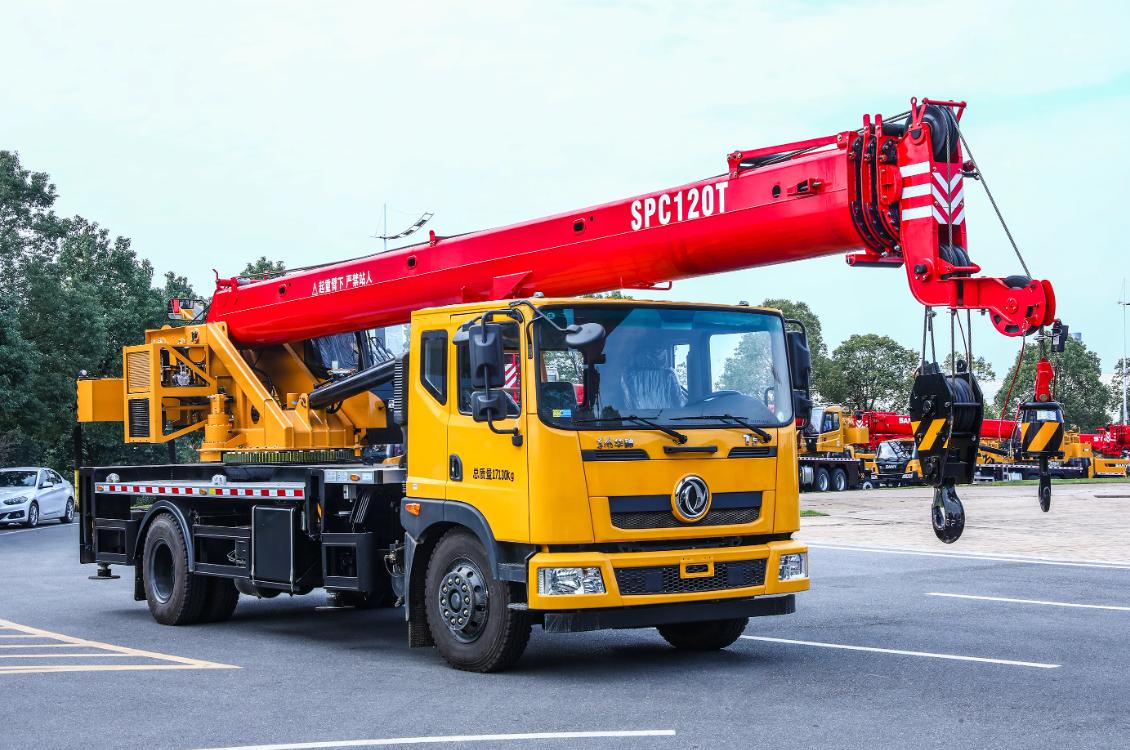
Vehicle-Mounted Jib Crane
The most mobile type, constructed with high-strength steel and bolted onto trucks or trailers. Turns ordinary vehicles into mobile lifting platforms, widely used in construction, utility services, roadside assistance, and heavy equipment maintenance.
Key Features: Telescopic boom reaches poles, roofs, or construction sites, operating reliably under adverse weather or terrain. Mainly used for on-site loading/unloading, placing heavy construction materials, tools, or prefabricated components, and improving operational efficiency.
Note: Distinguish this from a truck crane. Vehicle-mounted jib cranes are “jib cranes mounted on standard vehicles,” offering low-cost, flexible mobility. Truck cranes are “specialized cranes built on dedicated chassis,” focused on high load capacity and operational stability, falling under the “wheeled crane” category.
_182521.jpg)
Benefits of Jib Cranes
Jib cranes are widely used across various industries due to their numerous distinct advantages:
Flexible and Efficient Operation
Jib cranes can achieve 360° rotation (180° for some types), allowing the lifting mechanism to quickly move materials within a fan-shaped area without relying on overall track movement, reducing adjustment time. They are easy to operate, with precise control of lifting, rotation, and lowering via a console or remote control, making them highly efficient and suitable for assembly lines or frequent loading and unloading tasks.
Space-Saving Design
With a compact structure, column-mounted jib cranes occupy minimal floor space, wall-travel or wall-mounted models rely on walls or columns for support, and mobile units can be stored in corners when not in use. They are ideal for narrow workshops, small warehouses, or other space-constrained environments, optimizing limited space and improving work area utilization.
Easy Installation and Maintenance
Featuring few core components and no complex civil works, freestanding jib cranes use anchor bolts, while wall-travel or wall-mounted cranes rely on expansion bolts, resulting in short installation cycles and low costs. Routine maintenance is limited to lubricating and inspecting critical lifting and rotation components, reducing downtime and ensuring stable operation.
Reliable Safety Performance
Equipped with multiple safety devices such as overload limiters, brakes, and upper-limit stops, jib cranes effectively prevent overloading, overwinding, over-rotation, and over-travel, avoiding falling loads, equipment damage, and personal injury. Their structural design follows mechanical principles, using high-strength steel, and is rigorously calculated for strength and stability, ensuring safe operation within rated capacities.
Cost-Effective
Mid-sized jib cranes are priced lower than bridge, gantry, or tower cranes, fitting the budgets of small and medium enterprises. They also feature low energy consumption, minimal maintenance costs, and a service life exceeding 10 years under normal use, providing long-term economic benefits.
Where Are Jib Cranes Used?
Thanks to their flexibility, efficiency, and space-saving features, jib cranes play a significant role across multiple industries:
Industrial Production: As a core workshop handling device, suitable for machinery manufacturing, automotive parts production, and electronics assembly. They handle tasks such as loading/unloading machine tools, assembling heavy components, and transporting light precision parts, reducing labor intensity, improving efficiency, and ensuring operational safety.
Logistics and Warehousing: Used in small to medium warehouses, distribution centers, and temporary yards for loading, unloading, handling, stacking, and sorting goods. Ideal for long or narrow material storage, mobile models also meet temporary outdoor handling needs.
Construction: Useful in small-scale buildings, interior renovation, and localized construction. Can move building materials, install small components, and operate efficiently in tight spaces without damaging finished areas.
Other Specialized Fields: In ship engine rooms for part installation and maintenance; in metallurgical workshops for small metal ingot handling; in food processing, stainless steel models transport raw materials or finished products while meeting hygiene requirements.
How to Choose the Right Jib Crane for Your Project?
Selecting a jib crane requires balancing operational needs, environment, equipment performance, and brand reliability. Core steps include:
1. Clarify Operational Requirements
Rated Load: Select based on total material plus lifting accessories weight, with a 10%-20% margin to prevent overloading.
Working Radius: Determine by operational area size and furthest handling distance; cover the requirement without oversizing, which may increase costs or reduce stability.
Lifting Height: Include floor-to-platform height and material height, adding 0.5–1m for safety clearance.
Frequency of Use: Choose a higher duty class for high-frequency tasks, a lower class for less frequent use to reduce costs.
2. Analyze Environmental Conditions
Space Dimensions: Narrow workshops suit freestanding or wall-mounted cranes; cross-station movement requires wall-mounted; temporary tasks suit mobile cranes. Consider height limits to avoid collisions during boom rotation and lifting.
Floor and Wall Conditions: Freestanding cranes need adequate floor load capacity; wall-mounted cranes require sufficient wall or column strength. Reinforce if necessary.
Environmental Factors: High-temperature environments require heat-resistant components; humid or corrosive conditions call for stainless steel or anti-corrosion coatings; dusty environments need well-sealed mechanisms.
3. Consider Equipment Performance and Configuration
Duty Class: Match work frequency and load variations; avoid low class that may wear quickly or high class that wastes resources.
Drive Type: Light loads ≤0.5 tons and low frequency favor manual drive; heavy or frequent use favors electric drive for efficiency.
Safety Devices: Ensure overload limiters, brakes, and stop limits are in place; special environments may require explosion-proof or heat-resistant safety devices.
4. Prioritize Reputable Brand Products
Jib cranes are long-term machinery, so it is recommended to choose a strong, reputable brand like SANY to ensure proper selection and a reliable long-term user experience.
Reliable Quality and Low Failure Rate: Established brands have complete certifications and strong technical capabilities. Their products undergo rigorous testing, feature stable structures and durable components, and offer dependable quality, effectively reducing the risk of mechanical failures.
Worry-Free After-Sales Service: Top brands provide one-stop services including installation, commissioning, and maintenance. They respond quickly to service requests and maintain ample spare parts availability, minimizing equipment downtime and ensuring stable long-term operation.
Conclusion
What is a jib crane? From the detailed analysis above, it is clear that a jib crane is not a single model but a category of cranes characterized by flexibility, efficiency, and space-saving design. From loading and unloading machine tools in indoor workshops to handling goods in outdoor temporary yards, from transporting lightweight precision components to assembling medium- to small-sized heavy loads, jib cranes can meet diverse requirements with their various types and adaptable performance. When selecting a jib crane, considering operational needs, environmental conditions, equipment configuration, and brand reliability will help choose a cost-effective and long-term stable solution, providing strong support for improved production and operational efficiency.
FAQs
What is the difference between a crane and a jib crane?
A crane is a broad term that encompasses all machinery used for lifting and transporting materials. A jib crane, however, is a specific type of crane characterized by a “vertical support plus a horizontal rotating jib.” It focuses on small-range, high-frequency handling of medium to light loads, with an operational area forming a fan shape around the support point. Jib cranes are simpler to install and maintain. In short, a jib crane is a subset of cranes—the relationship is one of “general category versus specific type.”
What is a jib on a crane used for?
What is the jib of a crane? The jib of a crane is a core structural and operational component. Its main purposes are:
Extending the working radius: The horizontally projecting structure allows the hook to cover the area around the support point, overcoming the limitations of “fixed-point lifting.”
Precise material positioning: The jib can rotate, and in combination with the hoisting mechanism, it can smoothly deliver materials to any workstation within a small area. This is particularly useful in tight spaces or precision assembly scenarios, avoiding inefficiency or space occupation caused by moving the entire crane.
What is another name for a jib crane?
Depending on its structure or application, jib cranes have several common alternative names. The most universal is the “swing arm crane”, named after the primary rotation of the jib. Wall-mounted jib cranes are often called “wall-mounted cranes” or “wall-traveling swing arm cranes”. Freestanding jib cranes may also be referred to as “pillar-mounted swing arm cranes.” In some smaller applications, they might be called “mini swing cranes,” but “jib crane” and “swing arm crane” remain the most widely used and recognized terms.
What is the difference between a boom and a jib?
The boom usually refers to the crane’s main lifting arm, which is the primary load-bearing component. It connects directly to the crane body or tower head, bears the main load, and is often a rigid arm that can extend or pivot. The boom determines the crane’s maximum lifting height and base working radius.
The jib is an auxiliary arm installed at the end of the boom. Its function is to extend the working radius or height of the boom, handling only lighter loads. It is more lightweight in structure and is typically used for long-reach or high-altitude light-load operations that the main boom cannot cover.
In short, the boom is the main load-bearing arm, while the jib is the auxiliary extension arm—they function together as a “primary-secondary” system.
Featured Products
Recommend Blogs
Which Two Cranes Typically Use a Lattice Boom? A Complete Guide to Crawler vs. Truck Cranes
This article details which two cranes typically use a lattice boom, compares crawler cranes and truck cranes, and provides practical purchasing advice.
Types of Cranes: Your 2025 Comprehensive Guide to Every Major Category
As 2025's latest authoritative guide to types of cranes, this article breaks down the four types' core traits and application differences, giving engineers and equipment purchasers key selection criteria