Telehandler Attachments Guide: Application Scenarios, Selection Points and Replacement Guide
Are telehandler attachments suitable for installation? This article will introduce telehandler attachments, as well as share practical replacement guides.
The flexibility and efficiency of telehandlers lie in adapting to a variety of attachments and usage scenarios. The right choice of attachments—such as telehandler buckets and telehandler forks—directly determines both operational efficiency and on-site safety. From material handling at construction sites, bulk material loading and unloading in the agricultural field to precise construction of aerial work, different telehandler attachments correspond to different operational needs. Daily maintenance is also the key to ensuring their long-term stable operation. This article will detail the types and applicable scenarios of various telehandler lifting attachments, and share practical daily maintenance guides to help with efficient operations and reduce losses.
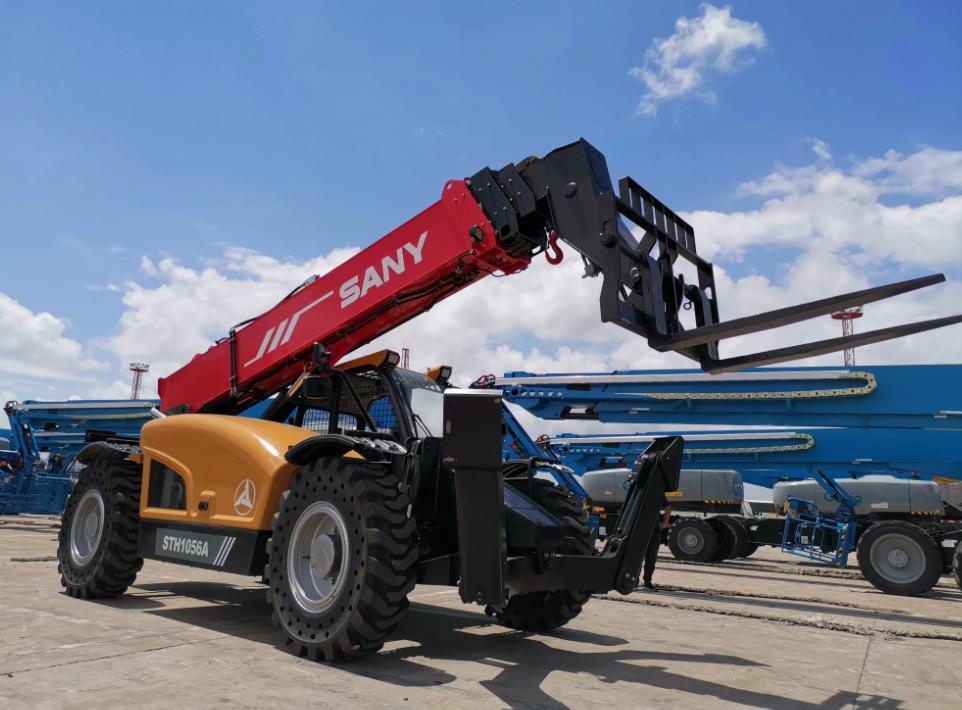
7 Major Telehandler Attachments: Enhance Telehandler Performance
To meet the diverse operational needs of different industries, you can choose suitable attachments for your telehandler to efficiently complete various tasks such as the safe lifting of personnel and precise handling of heavy objects. The following introduces 7 core telehandler attachments, detailing their functional characteristics and corresponding application scenarios, helping you select accessories accurately and improve operational efficiency.
1. Telehandler Bucket
As a core attachment of telehandlers, the telehandler bucket is an essential accessory in engineering, mining, operation and maintenance, and agricultural fields. It can greatly improve the handling efficiency of heavy materials and fully release the operational potential of the equipment.
Classification of Telehandler Bucket Attachments
General-purpose buckets: Focus on the picking and loading operations of bulk materials, suitable for the transfer of shapeless bulk materials such as soil, sand, and gravel.
Grapple buckets: Equipped with an exclusive hook structure, which can firmly grasp large or irregularly shaped materials such as logs, garbage, and construction debris.
Concrete mixing buckets: Integrate mixing and distribution functions, which can directly complete concrete mixing and unloading on the construction site, greatly saving construction time.
Application Scenarios
Loading, lifting and transferring operations of various bulk materials.
Short-distance handling of bulk materials such as sand, gravel, soil, and dregs.
Earth excavation operations in site leveling and foundation construction.
Cleaning and transferring of waste and debris at construction and agricultural sites.
Heavy-duty operation scenarios that require improving material handling efficiency.
2. Telehandler Forks
Telehandler Forks are one of the most commonly used telehandler lifting attachments. They are mainly used for lifting and moving palletized goods. The fork tines can be flexibly adjusted to adapt to materials of different sizes and specifications, enabling fast and damage-free handling. They are indispensable basic handling accessories in warehouses, construction sites and other scenarios.
Application Scenarios
Lifting and moving operations of palletized goods in warehouses, construction sites and other places.
Transfer scenarios of palletized goods of different sizes and specifications.
Handling tasks that require high material handling speed and need to avoid cargo damage.
Short-distance handling scenarios of various regular packaged materials and palletized finished/semi-finished products.
3. Telehandler Fork Carriages
Telehandler Fork Carriages are classic attachments for telehandlers. They can directly convert the equipment into a mobile forklift, and cooperate with the telescopic boom to achieve an ultra-long operating radius, combining the material handling function of a forklift with the high reachability of a telescopic boom. They are versatile basic attachments for multiple scenarios.
Application Scenarios
Loading, unloading and transferring operations of various materials such as palletized goods and bulk parts.
Cargo stacking and piling operations in warehouses, construction sites and other scenarios.
Handling scenarios with narrow operating space, complex terrain and high requirements for equipment mobility.
High-reach handling needs with large operating radius such as high-altitude material picking and high-level stacking.
Various construction and warehousing scenarios that require high precision and safety in material handling.
4. Telehandler Clamps
Telehandler Clamps are special attachments for telehandlers designed for irregular and heavy materials. They fix materials through mechanical clamping, replacing manual handling, which greatly improves operational safety and efficiency, while reducing material loss and labor costs. They are suitable for irregular heavy material handling needs in multiple industries.
Application Scenarios
Handling operations of irregular long/circular materials such as logs, pipes and bundles.
Transfer scenarios of heavy objects with large single weights that are difficult to handle manually, such as stone materials, steel plates and heavy components.
Handling of precision parts/fragile parts that require high protection of material appearance and need to avoid collision and damage.
Operating sites such as construction sites, warehousing and logistics that need to reduce manual input and control labor costs.
Production scenarios that pursue efficient and continuous operations and need to reduce downtime caused by manual handling.
5. Telehandler Hooks
Telehandler Hooks are versatile general-purpose attachments for telehandlers. Used with the equipment's telescopic boom, they have diverse load-bearing capacities, can flexibly extend the operating range and lifting height, not only ensuring the safety of workers' operations, but also reducing labor costs and improving operational efficiency. They are suitable for hoisting needs in multiple scenarios.
Application Scenarios
High-altitude hoisting, hanging and transferring operations of materials in narrow areas or hard-to-reach positions (such as high-rise frames, narrow alleys).
High-altitude installation and handling scenarios of beams, columns, trusses, equipment components and other items that need to be lifted and suspended at height.
Construction site and workshop operating sites that need to replace manual high-altitude hanging and handling of heavy objects to improve operational safety.
Hoisting operation scenarios in warehousing, construction, logistics and other fields that need to reduce manual input and control labor costs.
Hoisting and transferring scenarios that pursue continuous and efficient operations need to reduce downtime and maximize productivity.
6. Telehandler Jibs and Winches
Telehandler Jibs and Winches are excellent choices to expand the operational capability of telehandlers, especially indispensable in the construction industry. Working together, they can endow telehandlers with functions similar to cranes, which can not only extend the operating range, precisely control the load, but also improve operational safety and cost-effectiveness, adapting to various complex hoisting scenarios.
Application Scenarios
Precise positioning and placement operations of heavy objects such as beams, columns, roof trusses and large bulky components.
Material hoisting and placement in positions that are difficult to reach directly, such as behind obstacles and narrow areas.
Scenarios with limited operating space (such as indoor high floors, narrow alleys) that require hanging and placing heavy objects.
Hoisting tasks that need to extend the operating radius of the telehandler and break through the original reach limit of the equipment.
Operating sites in construction, infrastructure and other industries that need to replace special cranes, reduce additional manual and equipment input, and control costs.
Heavy hoisting scenarios that require high hoisting precision and load control, and need to improve operational accuracy and safety.
7. Telehandler Platforms
Telehandler Platforms are essential accessories for telehandlers used in aerial work. Specifically designed for aerial work scenarios, they can provide workers with a safe and stable aerial working space, effectively improving operational safety and productivity, while reducing downtime. They are suitable for aerial work needs in multiple industries.
Application Scenarios
Construction, operation and maintenance, cleaning and other scenarios that require construction operations, equipment maintenance and wall cleaning at height.
Tasks such as high-altitude installation and maintenance (such as lamps, pipelines and curtain walls) that require workers to operate stably at height.
Complex scenarios where it is difficult to set up scaffolding, such as narrow areas and around obstacles, and safe aerial work is required.
Operating sites that pursue efficient aerial work and need to reduce downtime caused by equipment adjustment and personnel position change.
Various venues (such as construction sites, workshops and venues) that have strict requirements on the safety of workers' aerial work and need to provide a stable working space.
How to Choose a Telehandler Based on Telehandler Attachments?
Telehandler Attachments are the core of a telehandler's operational capability, and their characteristics directly affect the equipment's lifting, balancing, and other performance. Choosing a suitable telehandler requires matching attachments with equipment performance, combining operational needs, and ensuring safety and efficiency.
1. Clarify Load Requirements: Combine the Material Characteristics Adapted by the Attachments
The weight and type of materials determine the selection of equipment load capacity, which is also the basis for matching attachments with equipment. Different attachments correspond to different materials: for example, pallet forks are suitable for regular pallets, hooks for heavy components, and buckets for bulk materials. It is necessary to calculate the weight and consider the stability of materials to avoid hazards caused by mismatched loads.
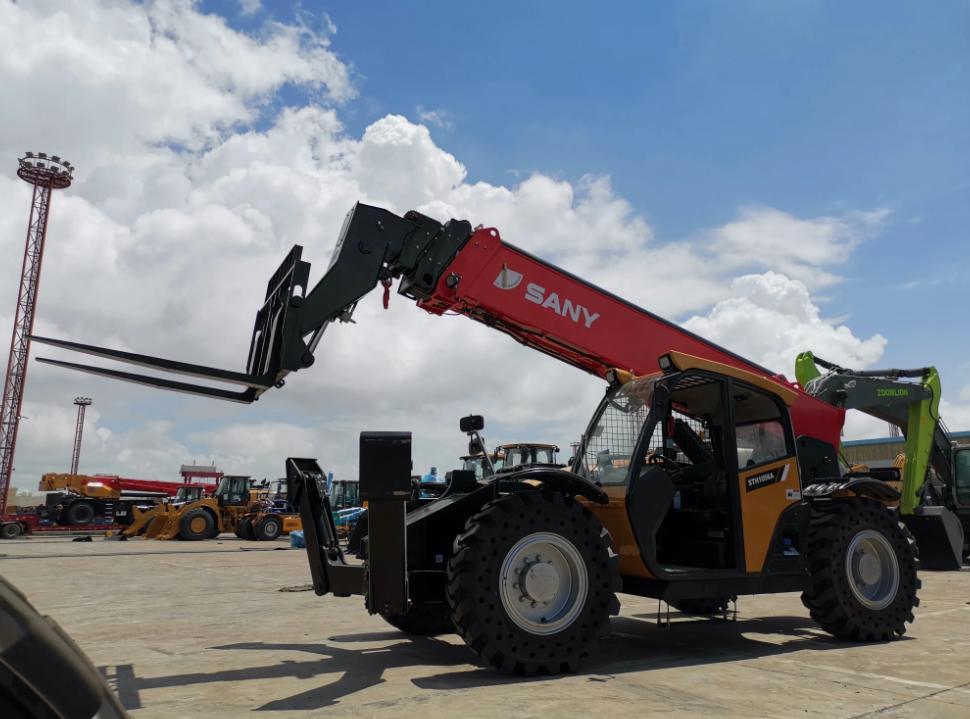
For instance, if you choose SANY telehandlers, you can achieve a maximum lifting height of 10 - 17.1 meters, with a rated capacity of 2.7 - 5.5 tons, which can bring you more efficient construction.
2. Match Operating Height and Boom Reach: Adapt to the Operating Range of the Attachments
The operating range of attachments is directly related to the equipment's telescopic height and forward extension distance. For aerial work attachments, equipment with sufficient boom reach should be selected, with a safe margin reserved; for low-altitude work attachments, equipment with moderate boom reach can be selected according to the site, balancing flexibility and economy, and ensuring operational safety.
3. Adapt to Operating Terrain: Ensure Coordinated Operation of Attachments and Equipment
Terrain determines equipment mobility and stability, and affects attachment efficiency. For rough outdoor terrain, off-road equipment should be selected, adapted to attachments such as off-road buckets; for flat indoor sites, electric narrow-body equipment can be selected, adapted to pallet forks, etc.; for complex terrain, additional attention should be paid to equipment stability to avoid safety issues.
4. Distinguish Operational Needs: Precisely Match Equipment Control and Power
Different attachments have different requirements for equipment control precision and power. For precision placement attachments, equipment with flexible control should be selected; for large-batch handling attachments, equipment with strong power should be selected to achieve precise adaptation, reduce delays, and maximize operational efficiency.
Telehandler Attachments Replacement Guide
Replacing telehandler attachments must strictly comply with safety regulations to eliminate potential hazards, ensure standardized operations, and avoid problems caused by differences in manufacturer-specific systems. Timely replace attachments that are excessively worn, damaged, or have reduced load-bearing capacity.
Key Steps for Replacing Attachments
1. Preparation: Park the telehandler on solid, level ground to ensure the machine is stable.
2. Removal Operation: Place the current attachment steadily on the ground, disconnect the hydraulic connectors (if any), and remove the safety pins and locking mechanisms.
3. Connection Operation: Align the boom head with the carriage of the new attachment. After engaging the attachment, securely fasten all safety pins.
4. Verification Test: Perform "crowd" and off-ground tilt tests to confirm that the new attachment is fully locked and free from loosening hazards.
Key Considerations for Replacing Attachments
1. Compatibility: Ensure the attachment carriage type is fully compatible with the telehandler to avoid installation failure or abnormal operation.
2. Hydraulic System: Ensure the hydraulic flow and pressure requirements of the new attachment match the equipment to guarantee the normal operation of the hydraulic system.
3. Capacity Adaptation: New attachments will change the equipment's load chart. Consult the manufacturer to obtain the updated lifting capacity parameters.
4. Comprehensive Inspection: After replacement, check the attachment for cracks, bent components, hydraulic leaks, or other issues to ensure the attachment is in good condition.
Conclusion
In summary, understanding the telehandler attachments guide is key to unlocking the full potential of telescopic boom forklift operations. Selecting, using, and maintaining telehandler attachments properly can not only maximize operational efficiency and reduce losses but also ensure operational safety. It helps various industries achieve efficient, safe, and low-cost operational goals, and gives full play to the multi-functional value of telehandlers.
FAQs
What Are Common Telehandler Attachments?
Common telehandler attachments enhance the machine's versatility in construction, agriculture, material handling and other fields. The main optional attachments include:
Standard Carriage Forks: The most widely used, suitable for handling palletized goods, timber and other packaged materials, featuring high versatility and lifting capacity.
Material Buckets: For transporting bulk materials such as sand, gravel and soil, ideal for site clearing and preparation.
Jib Booms/Truss Arm Connectors: Applied in roofing projects and steel structure installation, enabling precise hoisting of long components like beams, columns and trusses.
Grapple Forks/Bale Forks: Used in agricultural and other scenarios to securely fix irregular loads such as logs and hay bales.
Work Platforms: Allowing temporary aerial work for maintenance and repair tasks.
What Types of Lifting Gear May Be Used with a Telehandler?
Telehandlers use a variety of quick-connect lifting gear to lift, place and move materials, with the most common ones being:
Pallet Forks: For handling palletized goods of different specifications, suitable for warehouse and construction site scenarios.
Various Buckets: Including general-purpose buckets, grapple buckets and concrete mixing buckets, used for loading and unloading bulk materials or gripping irregular objects.
Jib Booms and Crane Hooks: Transforming the telehandler into a small crane for hoisting large materials such as beams, columns and trusses.
Work Platforms: Providing a safe operating area for aerial work.
Discharge Rakes, Concrete Skip Buckets and Bale Clamps: Adapted for container unloading, concrete conveying and agricultural bale handling respectively.
What Are the Three Types of Lifts?
Aerial work platforms are mainly divided into three categories:
- Scissor Lifts: Achieving vertical lifting via a hydraulic structure, available in electric (suitable for indoor use) and rough-terrain (suitable for uneven outdoor ground) models, with a lifting height ranging from 15 to 50 feet.
- Boom Lifts: Including straight boom, articulating boom and towable types, capable of navigating around obstacles to access hard-to-reach aerial areas, commonly used in landscaping, construction and other scenarios.
- Telehandlers: Combining lifting and aerial work capabilities, compatible with a variety of attachments and suitable for rough outdoor terrain, available in telescopic and rotating models.
Featured Products
Recommend Blogs
Agricultural Telehandler: Types, Applications & 2026 Buying Guide
This article introduces the composition, types, application scenarios, and key selection points of agricultural telehandlers.
Construction Telehandler: Everything You Need To Know
This article details the Construction Telehandler, covering its applications, selection, and common issues for industry reference.
What Is a Telehandler? Key Functions, Principles & Application Scenarios
This article explains what a telehandler is, outlining its components, functions, uses, and types. It also compares telehandlers with forklifts and cranes to help you choose the right equipment.