Skid Steer Loading Guide: Key Steps, Practical Tips & Pitfall Avoidance
This guide outlines skid steer loading and transport procedures, highlighting common errors and providing practical avoidance methods.
Skid steer loading is a critical operation in construction, agriculture, and various heavy-duty work sectors. Improper operation can easily lead to equipment damage, safety accidents, and even legal violations. Whether transporting skid steer loaders to a new construction site or storing them for maintenance, mastering the standardized procedure for how to load a skid steer is a core prerequisite for ensuring operational efficiency and transportation safety. This article breaks down the step-by-step operating procedures for loading skid steer loaders, outlines common mistakes and avoidance methods, and answers frequently asked questions in practice, providing operators with practical and instructive reference content.

How to Load a Skid Steer
The following eight core steps break down the standardized process of how to load a skid steer on a trailer. Operators should read them carefully.
1. Choose the Right Trailer for Skid Steer Loading
Confirm that the trailer's load-bearing capacity exceeds the weight of the skid steer loaders and that its dimensions match the equipment to avoid overloading.
Select the appropriate type: flatbed trailer (general purpose), tilt trailer (general purpose), ladder trailer (for larger skid steer loaders), or detachable gooseneck trailer (for extra-large industrial skid steer loaders). Note that similar carrier selection principles apply to skid steer loading on trucks as well as trailers.
Ensure the trailer hitch is compatible with the towing vehicle's capacity and check that the trailer tires, brakes, fastening points, hydraulic hoses, and other components are in good working order.
2. Check the Ground and Park the Trailer
Choose a flat, stable, and unobstructed surface, avoiding rough or sloping terrain.
Keep the trailer and skid steer loaders aligned in a straight line, ensuring no obstructions and simplifying the loading angle.
Engage the trailer brakes and place wheel chocks on the front and rear wheels to prevent the trailer from shifting during loading.
3. Prepare the Skid Steer
Fully lower the bucket and boom to the ground to lower the equipment's center of gravity and prevent tipping during transport.
Turn off the engine, engage the parking brake, and ensure the equipment is stationary.
Clean the equipment surface, drain excess fluid, and remove or secure loose parts and accessories.
Inspect the condition of critical components such as tires, tracks, and fastening points; disconnect the battery or fuel tank if necessary.
4. Lower and Secure the Trailer Ramps
Fully extend the ramp and ensure it is firmly pressed against the ground, ensuring there is no looseness or tilting.
Secure the ramp with locking devices to prevent displacement or slippage during loading.
Inspect the ramp for integrity to avoid safety hazards caused by damage or incomplete deployment.
5. Line Up the Skid Steer with the Trailer
Position the skid steer loaders directly in front of the ramp, ensuring the equipment is centered and the tires or tracks are precisely aligned with the ramp.
Observe the surrounding terrain, avoiding uneven surfaces that could affect alignment. If visibility is obstructed, an observer should be present to assist.
Confirm that there are no obstructions between the equipment and the trailer, allowing sufficient operating space.
6. Drive the Skid Steer onto the Trailer and Park for Balanced Weight
Drive the equipment smoothly and at a constant speed uphill, avoiding sudden acceleration, braking, or steering. Keep the bucket low to maintain equipment balance during operation.
Park the equipment above or in front of the trailer axle, ensuring a balanced weight distribution of 70% on the main load-bearing area and 30% at the front.
All attachments must be folded towards the bottom of the trailer to prevent them from protruding and affecting securing or transport.
7. Secure the Skid Steer for Transport
Use a sturdy chain or belt appropriate for the weight of the equipment and secure it to the designated fastening points on the equipment and trailer.
Tighten the fastening devices evenly to ensure the equipment has no room to shift while avoiding damage to its surface.
Lock the gearbox and brakes, and close all doors, covers, and hinges.
Cover the equipment with a waterproof sheet or shrink wrap to prevent dust, moisture, or debris from entering.
8. Final Checks before Hitting the Road
Double-check the secureness of the fasteners to ensure they are not loose or displaced.
Verify that the equipment's weight is evenly distributed and does not exceed the trailer's load-bearing capacity.
Check the trailer's lights, brakes, and tires to ensure they meet driving requirements.
Ensure the driver's view is unobstructed and that the equipment does not obstruct vehicle operation or emergency exits.
Confirm compliance with local, state, and federal transportation regulations to avoid fines.
Common Skid Steer Loading Mistakes to Avoid
Error 1: Selecting a Trailer with Mismatched Load Capacity or Dimensions
Reason: Failure to verify the actual weight of the equipment;
Consequence: Overloading the loader can lead to tire blowouts, frame deformation, and equipment slippage, causing traffic accidents;
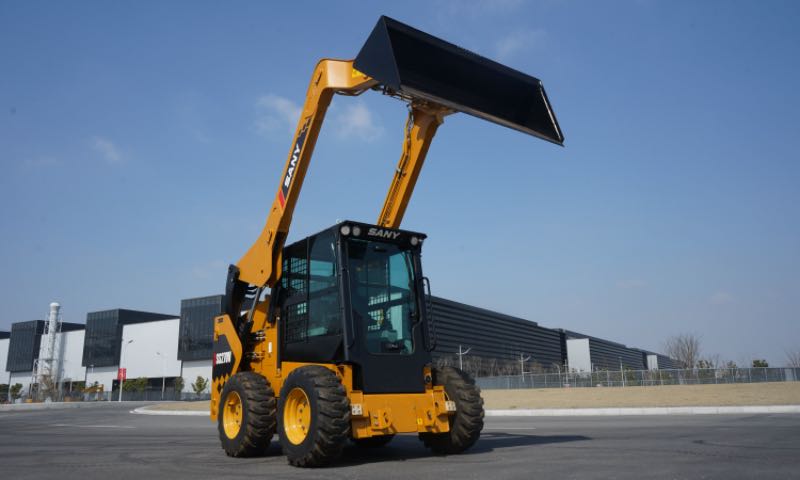
Prevention Method: Measure the actual weight of the equipment with a weighing instrument to ensure that the loader's rated load capacity is greater than or equal to the equipment weight, and that its dimensions cover the entire length and width of the equipment. For example, if the SANY Skid steer loader (SS270V) weighs 3.01 tons, then the loader's rated load capacity must be greater than 3.01 tons.
_173421.png)
Error 2: Parking Trailers on Uneven or Soft Ground
Cause: Failure to check ground load-bearing capacity and flatness;
Consequence: Carrier sinks, causing ramps to tilt, equipment to tip over while on ramps, or carrier shifting, affecting alignment;
Prevention Method: Load-bearing capacity and flatness must be checked on cement ground; thick steel plates (covering the bottom of the carrier) must be laid on muddy ground.
Error 3: Equipment Fails to Lower Bucket and Boom
Cause: Operator forgets to operate, or believes no adjustment is needed for short transport;
Consequence: Equipment center of gravity is too high, causing it to sway and tip over during transport, or the boom may collide with the trailer;
Prevention Method: Before shutting off the engine, the bucket must be lowered to the ground and the boom retracted. Get out of the vehicle and manually push the boom to confirm it is not suspended in the air. If it cannot be lowered to the ground, use wooden blocks for support.
Error 4: Ramp Not Secured or Not Fully Deployed
Cause: Ramp locking device not checked, or ramp malfunction not repaired;
Consequence: Ramp slips while equipment is on ramp, equipment falls off, damaging equipment and injuring personnel;
Prevention Method: After ramp deployment, ensure bottom is fully in contact with the ground, engage locking device, manually pull ramp to ensure it is not loose, check ramp for cracks, deformation, and oil stains.
Error 5: Uneven Loading Due to Misalignment during Loading
Cause: Obstructed driver's view, no observer assisting;
Consequence: Equipment weight shifts to one side, carrier tilts, rollover during driving, or tire blowout due to excessive localized stress;
Prevention Method: Use ground guide lines or a measuring tape to ensure the equipment is aligned with the ramp's centerline. If the view is obstructed, have an observer present. After alignment, get out of the vehicle and measure the distance between the two ends.
Error 6: Use of Insufficiently Strong Fastening Devices or Improper Fastening Locations
Cause: Using inferior fastening devices to save costs, or not knowing the proper fastening locations.
Consequence: Fastening devices break, equipment moves during transport, collides with the carrier or other vehicles, and the equipment surface is damaged.
Prevention Method method: Use sturdy chains or belts, select dedicated marking points on the equipment and carrier for fastening, pad the contact points with rubber pads, and use a torque wrench to ensure even tightening force.
Error 7: Ignoring Equipment or Carrier Component Malfunctions
Cause: Inadequate inspection, assuming minor malfunctions will not affect transportation;
Consequence: Component failure during transportation, such as hydraulic hose leaks causing inability to secure ramps, or tire leaks causing carrier imbalance;
Prevention Method Method: Before loading, inspect each item of the equipment (tires/tracks, fastening points, hydraulic system), carrier (tires, brakes, lights, hydraulic hoses). Repair any cracks, leaks, or wear immediately; do not transport vehicles with malfunctions.
Error 8: Failure to Comply with Transportation Regulations
Reason: Lack of understanding of local weight and size limits, or taking chances;
Consequences: Fines and vehicle impoundment by traffic police, delays in construction, and even increased risk of accidents;
Prevention Method: Check the local transportation department's website for regulations. If exceeding limits, obtain an "Overweight/Oversized Vehicle Permit" in advance to avoid illegal transportation.
Frequently Asked Questions and Solutions During Skid Steer Loading
1. How to Move Skid Steer Loaders without a Ramp?
When there is no ramp, the Skid steer loader operator can reverse to the trailer, balance it using the front wheels, and then use the bucket to carefully maneuver the skid steer onto the trailer. However, this method requires very precise operation and carries the risk of tipping over, machine damage, and operator injury, so it is generally not recommended. The best method is to purchase a set of loading and unloading ramps.
2. How to Choose a Suitable Loading/Unloading Ramp when Transporting Skid Steer Loaders?
Choosing a suitable loading/unloading ramp requires considering the following key factors:
Matching the weight of the skid steer loaders: The ramp's load-bearing capacity must exceed the weight of the skid steer loaders, including their own weight, fluids (such as hydraulic oil and engine oil), and accessories (such as the bucket).
Matching the trailer height: The ramp's gradient should be between 16 and 23 degrees. If the trailer is too tall, the ramp will be steeper, requiring a longer ramp to compensate.
Matching the required functions: Does it include connection points (to secure the ramp to the trailer) or side guards (to prevent skid steer loaders from slipping off)?
3. What Preparations Are Needed before Performing Skid Steer Loading Operations?
Conduct a risk assessment and document the steps taken to address the risks, as well as any potential shortcomings in these steps, to prevent the situation from spiraling out of control or causing unnecessary harm.
Equip the work site and personnel with personal protective equipment to reduce the likelihood of them facing risks during the transport operation.
Determine the weight and dimensions of the skid steer loaders to ensure smooth transport and avoid unnecessary fines, delays, or accidents.
Check the truck/trailer's power, rated load capacity, and operating condition to avoid potential problems.
Conclusion
In conclusion, skid steer loading is far from a simple routine procedure; it is a systematic task requiring attention to detail, strict adherence to safety regulations, and familiarity with equipment and trailer parameters. Following the standardized steps described in this article, avoiding common operational pitfalls, and strictly adhering to the 70/30 weight distribution principle can significantly reduce transportation risks and ensure a smooth and efficient transfer process. This not only protects valuable machinery but also provides a strong safety net for operators and other personnel on the road.
FAQs
What Is the 70 30 Rule Skid Steer?
The principle of weight distribution after skid steer loaders are loaded is that 70% of the equipment weight should be placed on the drive axle or main load-bearing area of the trailer, and 30% of the weight should be distributed in the front of the trailer. This ratio can ensure the stability of the trailer during transportation and avoid rollover or braking failure caused by uneven loading.
Should You Load a Skid Steer Forward or Backward?
For safety reasons, skid steer loaders are typically mounted on a trailer at the front. This concentrates the weight of the skid steer loaders above the trailer axle, which is crucial for towing safety; additionally, it positions the bucket at the front, preventing the machine from tipping forward.
What Is the Loading Capacity of a Skid Steer?
The loading capacity of skid steer loaders varies depending on the brand, size, and model. Factors such as accessory weight, ground conditions, and lifting height also affect the actual loading capacity. Generally, smaller models have lower loading capacities, while larger and heavy-duty models have higher capacities. Refer to the equipment's operating manual for specific values.
Featured Products


Recommend Blogs

Skid Loader Lift Capacity Explained: ROC vs Tipping Load & Load Weight
Learn about skid loader lift capacity, tipping load, and ROC. Understand factors affecting lift and how to calculate load weight safely.

How to Operate a Skid Loader? Comprehensive Guide to Efficient and Safe Operations
This article focuses on core components of the skid loader, how to operate a skid loader, safety knowledge, and common operations, helping construction teams carry out projects efficiently and safely.

What Is a Skid Loader? Meaning, Principle & Guide
This article provides a detailed analysis of what is a skid loader is, including its core components, working principle and application scenarios. It also compares different loaders and offer a practical selection guide.