How Much Does a Dump Truck Weigh? A Complete Guide
This article answers how much does a dump truck weigh, covering weight factors, calculation methods, and compliance & safety essentials.
Dump trucks are indispensable workhorses in construction, mining and material transportation. Yet one question remains at the top of mind: how much does a dump truck weigh? There is no one-size-fits-all answer. Dump truck weight varies dramatically depending on axle configuration, manufacturing materials, load capacity and operating conditions. Understanding these weight differences is crucial for safe operations, regulatory compliance, and work efficiency. Whether you are a project manager, driver, or industry enthusiast, understanding the weight of a dump truck provides valuable guidance for practical applications and helps maximize the equipment’s performance.
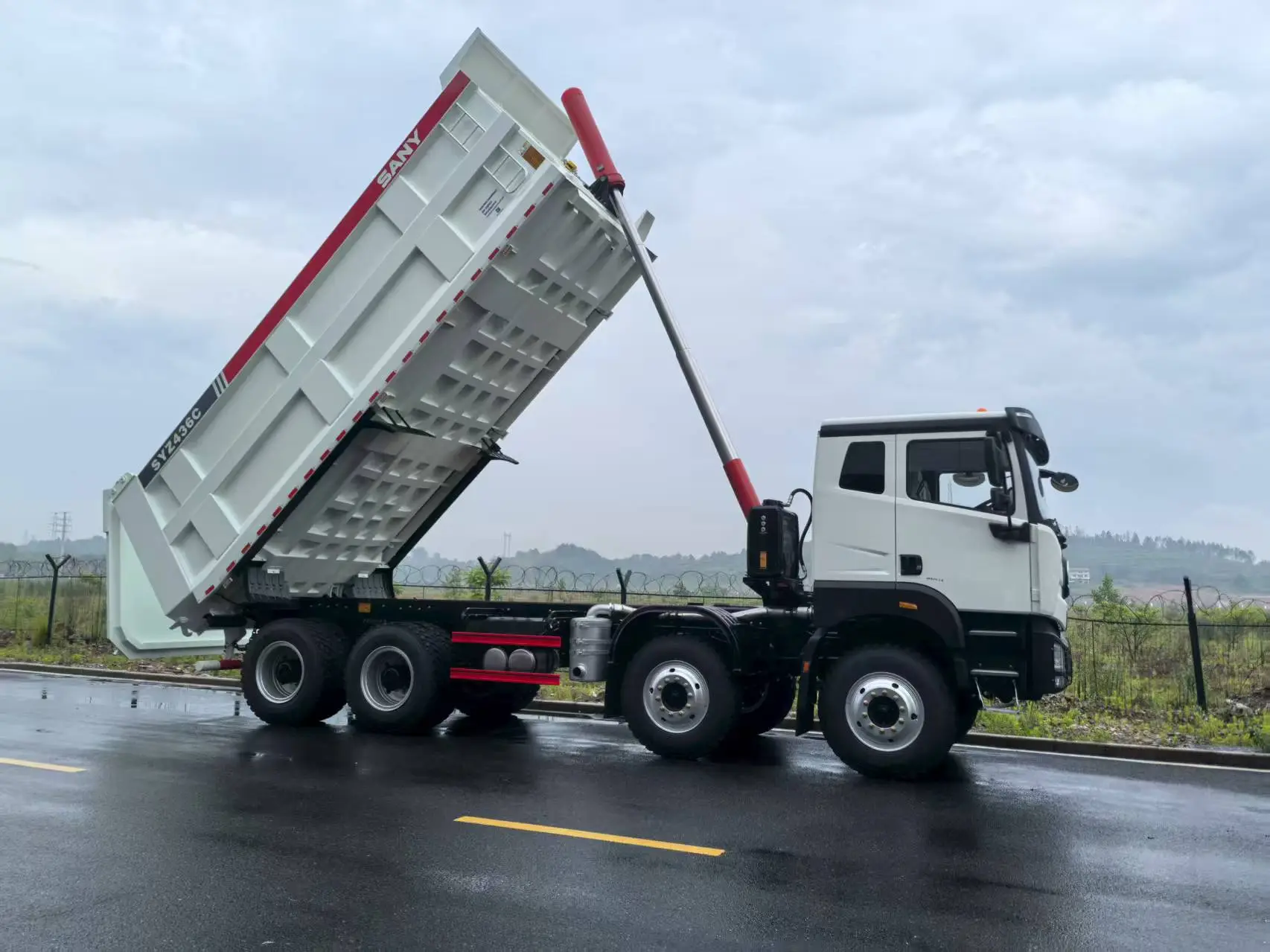
Different Types Of Dump Truck Weight
Dump trucks come in various shapes and sizes, each designed for specific purposes with distinct load capacities. Classified by the number of axles, they are generally categorized into two-axle, three-axle, four-axle and multi-axle models. Their features and weight parameters are as follows:
Single-axle/two-axle dump truck (4x2)
1. Features
These dump trucks have a single axle at the front and a single axle at the rear. They are simple in structure, low in cost, and flexible, but have a small load capacity. They are the mainstream configuration for light and small dump trucks.
2. Weight Parameters
Maximum Capacity: 8 tons or 6 cubic yards
Gross Load Weight: 32,000 pounds
Empty Weight: 15,100 pounds
3. Application Scenarios
Suitable for light-load tasks such as urban scattered muck removal and material transfer at small construction sites.
Dual-axle/three-axle dump trucks (6x2/6x4)
1. Features
The mainstream layout of three-axle dump trucks is a single axle at the front and a double axle at the rear (double rear wheel structure). They are the main force in engineering dumping, with dual rear axle drive and balanced load and traction.
2. Weight Parameters
Tri axle Dump Truck Capacity: 22 tons or 15 cubic yards
Gross Load Weight: 68,000 pounds
Empty Weight (Steel Body): 25,380 pounds
Empty Weight (Aluminum Body): 22,600 pounds
3. Application Scenarios
The capacity of a tri-axle dump truck is stronger than that of a two-axle dump truck, and three-axle dump trucks maintain excellent balance when operating on uneven terrain. They are ideal for large construction sites requiring fast and efficient material handling.
Three-axle/Four-axle dump trucks (such as 6x4 variants/8x4)
1. Features
Four-axle dump trucks are typically 14-wheel heavy-duty trucks, with two powered lowering axles and two unpowered axles. They offer increased load capacity, good stability, and moderate maneuverability.
2. Weight Parameters
They can handle longer and heavier loads, with a load capacity 25% to 50% higher than that of three-axle models.
3. Application Scenarios
Featuring aluminum cargo boxes, four-axle dump trucks are only suitable for transporting materials like stones, sand and gravel. They are widely recognized as the preferred option for long-distance transportation, especially interstate haulage.
Four-axle and above multi-axle dump trucks
1. Features
Multi-axle dump trucks typically feature a heavy-duty layout with two front axles and three/four rear axles, offering strong load-bearing capacity, high-end configuration, and optimized load-bearing systems.
2. Weight Parameters
They offer greater load capacity than four-axle models. For instance, a seven-axle dump truck has a Gross Vehicle Weight Rating (GVWR) of up to 80,000 pounds.
3. Application Scenarios
Primarily used for ultra-heavy material transportation in mining and large-scale infrastructure projects, such as hauling bulk ores and heavy construction materials. These trucks deliver exceptional stability and load-bearing capacity.
Quick Overview Table Of Weights For Different Dump Trucks
Dump Truck Type | Weight Specifications | Application Scenarios |
Two-axle | Max capacity: 8 tons/6 cubic yards; Gross load: 32,000 lbs; Empty weight: 15,100 lbs | Urban muck removal, material transfer at small construction sites (light-load tasks) |
Three-axle | Max capacity: 22 tons/15 cubic yards; Gross load: 68,000 lbs; Empty weight: 25,380 lbs (steel)/22,600 lbs (aluminum) | Uneven terrain operations, fast material handling at large construction sites |
Four-axle | Load capacity 25%-50% higher than three-axle models; handles longer/heavier loads | Aluminum body for stones/sand/gravel; long-distance and interstate transportation |
Multi-axle | Higher capacity than four-axle models; 7-axle model GVWR up to 80,000 lbs | Ultra-heavy material transportation in mining/large infrastructure projects (bulk ores, heavy building materials) |
Key Factors Affecting Dump Truck Weight
Material Factors
Density: The biggest variable; dense materials like wet sand or gravel weigh far more per cubic yard than light materials like mulch or wood chips, drastically changing total weight.
Volume: The amount of material (cubic yards/meters) directly adds to the truck's weight.
Truck & Design Factors
Truck Size & Type: Larger trucks (e.g., 8x4) have higher capacities than smaller ones (e.g., 6x4), but smaller trucks are better for light landscaping.
Body Material & Shape: Stronger, lighter materials (like high-strength steel) and U-shaped beds reduce empty weight and increase payload, improving efficiency.
Axle Configuration: More axles (tandem, tri-axle) distribute weight better, allowing for higher legal payloads. .
Operational Factors
GVWR (Gross Vehicle Weight Rating): The manufacturer's maximum legal operating weight (truck + fuel + operator + cargo).
Payload Capacity: The maximum cargo weight (GVWR minus truck's empty weight).
Tire Pressure: Higher pressure can allow for heavier loads but increases wear and risk; lower pressure reduces load capacity but provides a smoother ride.
Methods for Calculating Dump Truck Weight
1. Determine the Truck’s Empty Weight
Empty weight (dump truck empty weight) refers to the weight of the vehicle without any cargo, equipment or modified parts. It can be obtained through three reliable methods:
-Consult the vehicle operation manual
-Check the manufacturer’s nameplate located in the driver’s cab
-Conduct an actual weighing at an officially certified weigh station
For example, the curb weight of the SANY Dump Truck ranges from 16.2 to 42 tons, while the curb weight of the SANY Electric Dump Truck is 22.7 tons.

2. Calculate the Loaded Material Weight
Material weight is jointly determined by its density and cargo box volume. For instance, sand and gravel have a density of approximately 2,700 lbs per cubic yard. When a dump truck with a 20-cubic-yard cargo box is fully loaded with sand and gravel, the corresponding material weight reaches 54,000 lbs.
3. Factor in the Additional Weight of Modified Equipment
Some dump trucks undergo legal modifications or accessory installations, and these modified components and added equipment will also affect the truck’s total weight. For example, a hydraulic lifting system adds approximately 800 lbs. All modified parts’ weights must be fully accounted for in the calculation.
4. Sum Up All Weight Components
The total loaded weight of the vehicle can be obtained by adding the truck’s curb weight, loaded material weight, and additional weight of modified equipment. Take a dump truck as an example: it has a curb weight of 40,000 lbs, a 20-cubic-yard cargo box loaded with sand and gravel, and is equipped with a hydraulic lifting system. Its total weight is calculated as 40,000 lbs + 54,000 lbs + 800 lbs = 94,800 lbs.
Conclusion
How much does a dump truck weigh? As detailed in this article, the answer spans a wide range. A dump truck’s weight is jointly determined by axle configuration, manufacturing materials, cargo density and regulatory requirements. Accurate weight calculation and adherence to safety standards are the core of compliant operations. By mastering the factors affecting weight, following scientific calculation methods and implementing safe operating practices, industry professionals can fully leverage the value of these versatile machines while minimizing operational risks.
FAQs
What Is the Weight of a Dump Truck by Size Category?
Light-duty dump trucks: Categorized into Classes 1 to 3, where Class 1 has a weight of no more than 6,000 lbs, Class 2 ranges from 6,001 to 10,000 lbs, and Class 3 spans 10,001 to 14,000 lbs.
Medium-duty dump trucks: Covering Classes 4 to 6, with Class 4 weighing between 14,000 and 16,000 lbs, Class 5 from 16,001 to 19,500 lbs, and Class 6 ranging from 19,501 to 26,000 lbs.
Heavy-duty dump trucks: This category includes Classes 7 and 8. Class 7 has a weight range of 26,001 to 33,000 lbs, while Class 8 exceeds 33,000 lbs.
What Procedures are Required for Transporting Oversized or Overweight Cargo?
Transporting oversized/overweight cargo requires extensive planning, including obtaining special permits, detailed route planning to avoid height/weight restrictions, using specialized equipment (trailers, cranes), securing cargo with heavy-duty tie-downs, employing experienced drivers, arranging escort vehicles (pilot cars), and ensuring proper vehicle inspection and marking for safety and legal compliance, with coordination needed across jurisdictions.
How Much Asphalt Can Fit in a Dump Truck?
A dump truck can haul 6 tons to over 30 tons of asphalt, depending on the truck size (single, tandem, tri-axle, semi) and density, with common sizes being 12-16 tons for tandem trucks and 25-30 tons for large semi-dumps, always respecting legal weight limits and asphalt's density (around 2,500-2,900 lbs/cubic yard).
Featured Products
_194553.png)
Recommend Blogs
How to Choose the Right Dump Truck Sizes? The Ultimate Selection Guide
This article analyzes the core parameters of dump truck sizes to provide selection strategies and help projects balance efficiency and safety.

2026 Type Dump Truck Analysis And Selection Guide
This article introduces type dump trucks and provides a selection guide to help your fleet work smoothly.
How Many Cubic Yards In A Dump Truck? Load Capacity & Buying Guide
This article explains how many cubic yards in a dump truck and provides specific selection guidelines.