How Are Cranes Built? A Step-by-Step Guide to the Construction Process
Cranes help us build towering skyscrapers, yet few know how cranes are built. This guide takes you through an in-depth exploration of the process
In the modern construction industry, cranes are like steel giants, using their immense power and precise operation to lift heavy building materials to great heights, playing a key role in the construction of skyscrapers. So, how are cranes built? What are their working principles and key components? And how is operational safety ensured? This guide answers these questions through a comprehensive analysis.

How Do Cranes Work?
The core operation of cranes is based on mechanical principles. They primarily rely on power sources to provide energy, with various mechanisms working together to lift, move, and place heavy objects. The basic workflow is as follows:
- Power System (e.g., motors, internal combustion engines) drives the lifting mechanism, which uses wire ropes or chains to raise or lower the hook, enabling vertical material movement.
- Traveling Mechanism moves the crane or parts of it over tracks, roads, or other surfaces, expanding its operational range.
- Boom Lifting Mechanism adjusts the length and angle of the boom, altering the horizontal position of the load.
- Rotating Mechanism allows the boom to rotate around a swivel point, providing further flexibility in adjusting the work direction.
These mechanisms work in synergy, enabling cranes to accurately perform various lifting tasks.
The working logic of cranes can be summarized as: power-driven energy transfer → structural support for force balance → interconnected mechanisms enabling precise lifting. Despite structural differences among various types of cranes (such as overhead cranes, tower cranes, and truck cranes), their core principle remains the same—achieving the spatial transfer of heavy objects through "force transmission and control."
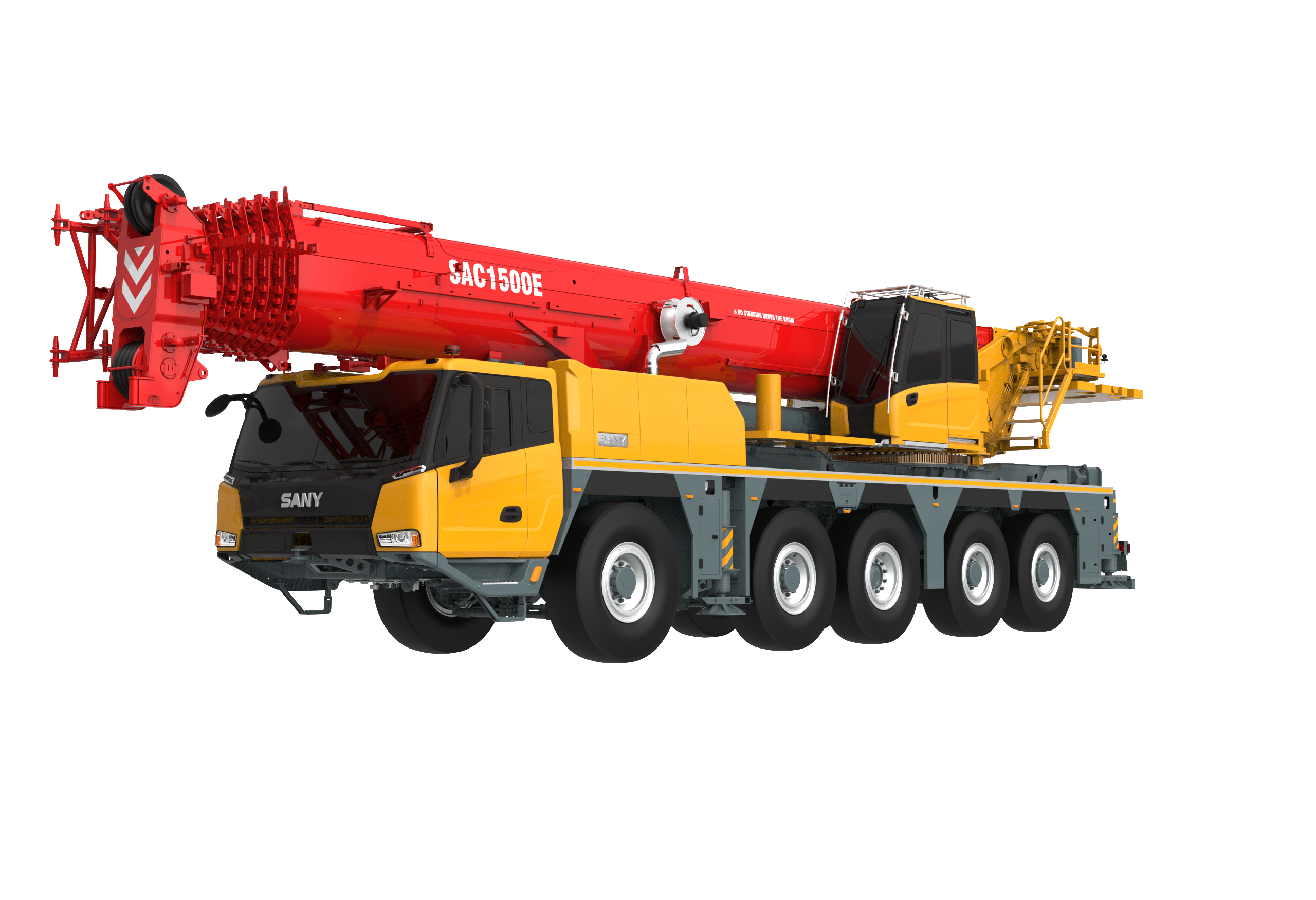
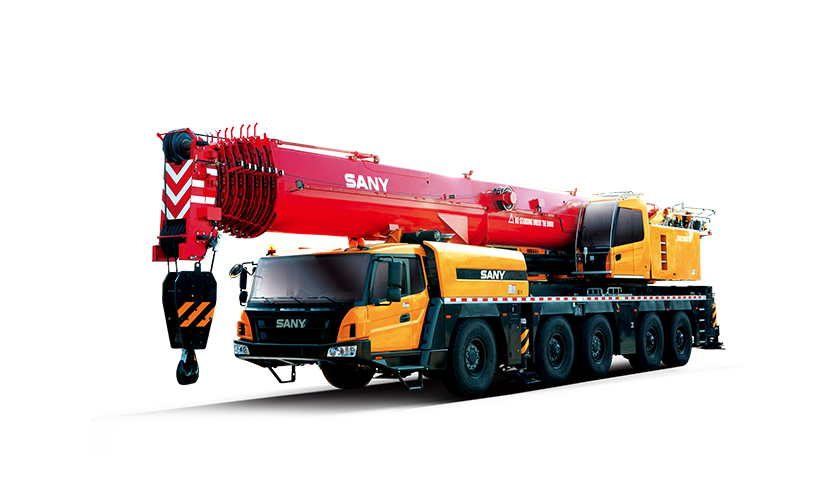
Some cranes feature more sophisticated designs in mechanism synergy, such as SANY All-terrain Crane series: their compact chassis, equipped with all-wheel steering and optimized suspension, can adapt to diverse job sites; while the variable boom configurations and flexible counterweight combinations further enhance the capability to handle complex operating scenarios.
How Are Cranes Built on Construction Sites?
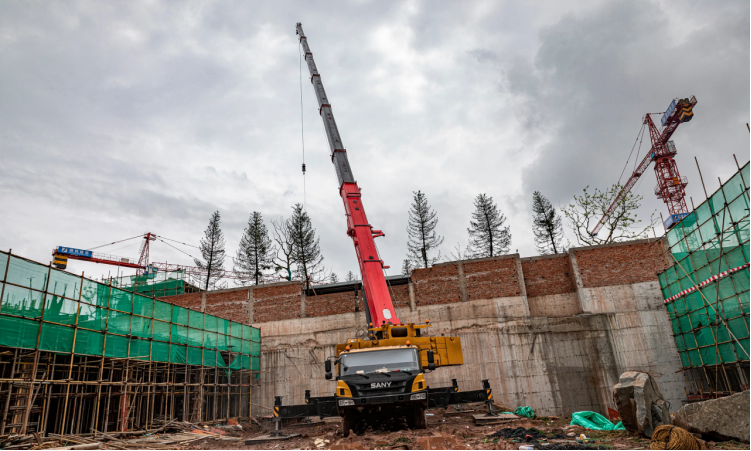
So, how are construction cranes built? It's a complex system that typically requires a phased approach:
- Design Phase: A crane plan is designed based on the construction site’s operational requirements, load-bearing specifications, and site conditions. The dimensions, materials, and performance parameters of each component are determined.
- Manufacturing Stage: Critical components such as the boom, tower, chassis, and power systems are produced according to the design specifications. The manufacturing process requires high-precision equipment and strict quality control to ensure strength and safety.
- Transportation and On-Site Assembly: The manufactured components are transported to the construction site. Using smaller cranes or pre-installed crane parts, the various components are gradually assembled, including the tower construction, boom installation, and connection of the power system.
- Commissioning and Testing: The crane’s mechanisms, safety devices, and operational functionality are tested to ensure it can operate safely and efficiently.
Cranes on construction sites (taking the most common tower cranes as an example, hereinafter referred to as "tower cranes") are not "built from scratch" on-site. Instead, the production of their core components is first completed in factories, and then they are transported to the construction site for on-site assembly and installation. The installation process must strictly comply with safety regulations and technical standards, with the main steps as follows:
1. Preliminary Preparation: Site Survey and Foundation Construction
The stability of a tower crane depends on a solid foundation, and the following must be completed before installation:
- Site planning: Determine the installation position of the tower crane (it must avoid obstacles, ensure the working radius covers the construction area, and stay away from hazardous sources such as high-voltage lines).
- Foundation design and construction: Based on the self-weight and maximum lifting capacity of the tower crane model, pour a reinforced concrete foundation (usually a square or circular bearing platform). The depth and reinforcement must meet load-bearing requirements. High-strength bolts are pre-embedded in the foundation to fix the tower crane's base (or undercarriage).
- Equipment delivery: Core components of the tower crane (such as tower standard sections, jib, counter jib, slewing mechanism, cab, counterweights, etc.) are transported to the site by large trucks. The transportation route and hoisting site must be planned in advance.
2. Foundation Acceptance and Base Installation
- After the concrete foundation has cured to reach the required strength, first inspect the foundation's flatness, the position of pre-embedded parts, and load-bearing capacity (must comply with the design drawings).
- Fix the tower crane's base (or undercarriage) to the foundation via pre-embedded bolts, ensuring the base is level (the error must be controlled within the specified range to prevent tower inclination).
3. Tower Body Assembly: Gradually Raising the "Framework"
The tower body is the vertical support structure of the tower crane, composed of multiple "standard sections" (each 1.5-3 meters long, welded from steel). During installation:
- Use a truck crane (or the already installed tower crane itself) to hoist the first standard section, and fix it to the base with bolts.
- Hoist subsequent standard sections in sequence, with each section connected via high-strength bolts, until reaching the required initial height (it can be further raised later via the "jacking mechanism" according to construction needs).
4. Installation of Slewing Mechanism and Upper Structure
- Slewing bearing: Install the slewing mechanism (including bearings and driving devices) on top of the tower body, allowing the upper part of the tower crane (jib, counter jib, etc.) to rotate 360°.
- Cab and electrical system: Install the cab on one side of the slewing mechanism, and connect the control panel and cables (connected to the ground distribution box to provide power).
- Counter jib: Hoist the counter jib (tail structure), fix it to the slewing mechanism, and install counterweights (usually concrete or cast iron blocks) according to the design to balance the load of the jib.
5. Jib Installation: Key Load-Bearing Component
The jib (lifting arm) is the core working component of the tower crane, with a length ranging from tens to hundreds of meters. During installation:
- First, connect the segments of the jib (main jib, auxiliary jib if applicable) on the ground via pins to form an integrated structure, and install luffing wire ropes (to control the jib's elevation) at the same time.
- Use a truck crane to hoist the assembled jib, connect it to the front hinge point of the slewing mechanism, then connect the head of the jib to the winch on the counter jib via wire ropes, and adjust the jib's angle to the horizontal or designed position.
6. Safety Devices and Commissioning
- Install core safety devices: Including load limiters (to prevent overloading), moment limiters (to prevent tipping), height limiters (to control lifting height), slewing limiters (to restrict rotation angle), etc.
- Commissioning: After powering on, test whether the lifting, luffing, and slewing mechanisms operate smoothly, whether the wire ropes are properly wound, and whether the safety devices are sensitive and reliable.
- Load testing: Verify the tower crane's load-bearing capacity and stability through test hoists with no load, rated load, and 1.25 times the rated load.
7. Acceptance and Certification
After installation is completed, it must be inspected by qualified third-party organizations and can only be put into use on the construction site upon passing the inspection. Going forward, regular inspections and maintenance are also required to ensure safe operation.
The "construction" of cranes on construction sites is essentially the on-site assembly of factory-prefabricated components. The core lies in transforming "disassembled parts" into "operational equipment" through precise mechanical connections, electrical control, and safety verification, which relies on the cooperation of professional teams and heavy hoisting equipment throughout the process.
Key Components of a Crane
Crane operation depends on many key components that support its functionality:
- Boom: The primary load-bearing component, used to suspend and move materials. It is typically made of high-strength steel and can be extended or retracted as needed.
- Lifting Mechanism: Includes the motor, gearbox, winch, wire rope, and hook, responsible for lifting materials. Its performance directly affects the crane's lifting capacity and efficiency.
- Rotating Mechanism: Composed of a slew bearing and drive system, it allows the boom and load to rotate 360 degrees, enhancing operational flexibility.
- Travel Mechanism: Can be wheeled, tracked, or mounted on rails, determining the crane's mobility and suitability for different site types.
- Control System: Operates the various mechanisms, including levers, buttons, and instruments. Some advanced cranes also feature intelligent control systems that enhance operational precision and safety.
Safety Considerations During Crane Operation
Ensuring the safety of both the crane operation and the workers is crucial. Operators must be professionally trained and certified, and they must be familiar with the crane's performance and operational standards:
Equipment and environmental inspection before operation
- Equipment inspection: Focus on checking whether lifting tools (hooks, chains, wire ropes, etc.) are worn, deformed, or broken; whether braking systems and limiting devices (load limiters, moment limiters, height limiters, etc.) are sensitive and effective; whether all connecting bolts are tight; whether hydraulic/pneumatic systems have oil/air leaks; and whether tires (for mobile cranes) or tracks (for rail-mounted cranes) are in good condition.
- Environmental inspection: Confirm the operation site is flat and solid with no risk of collapse; clear obstacles (such as high-voltage lines, buildings, cables, etc.) within the operation radius, and maintain a safe distance from high-voltage lines (in accordance with relevant standards based on voltage levels); check weather conditions. Operation is strictly prohibited in severe weather such as heavy rain, strong winds (exceeding the specified wind speed), or heavy fog.
Operational specifications
- Strictly abide by the "ten no-lifting principles": no lifting when overloaded; no lifting when signals are unclear; no lifting when loads are not securely bound; no lifting when pulling obliquely; no lifting when people are on the suspended load; no lifting when the load is buried underground; no lifting when safety devices fail; no lifting in dim light with unclear visibility; no lifting of angular objects without protective measures; no lifting when liquid metal containers are overfilled.
- A test lift is required before formal lifting: Hoist the load 10-30 cm off the ground, pause to check braking performance and stress on lifting tools, and proceed only if no abnormalities are found.
- Movements such as lifting, luffing, and slewing must be smooth and slow. Avoid sudden stops or turns to prevent load swinging or inertia-induced overloading and tipping.
- When moving a suspended load, keep it below obstacles in the operation area (such as scaffolding, buildings) and never allow it to pass over people. No one is allowed to stand or stay under the suspended load.
- It is strictly prohibited to use the crane to pull out objects buried underground (such as piles or steel bars with unknown weight) to avoid equipment damage or tipping due to overloading.
Emergency and special situation handling
- If abnormal equipment conditions (such as abnormal noise, oil leakage, or brake failure) are found during operation, stop immediately, lower the load, cut off the power supply, report to the relevant person in charge, and never operate faulty equipment.
- In case of sudden power failure or malfunction causing the load to hang in mid-air, the operator must remain calm, never leave the cab without authorization, immediately issue warning signals, set up a warning zone, and contact professionals for handling.
- When two or more cranes work together, a clear division of labor must be established, safe distances maintained to avoid mutual interference, and load distribution must comply with design requirements.
Post-operation procedures
- After the operation, park the crane in a flat, solid, and safe area, retract the boom and hook, cut off the power supply, and lock the cab.
- Clean the operation site, check the condition of all equipment components, keep operation records (such as faults and abnormalities), and hand over to maintenance personnel for subsequent inspection and maintenance.
Strict implementation of the above precautions can minimize safety risks during crane operation and ensure the safety of personnel and equipment.
Conclusion
As vital equipment in the construction industry, cranes have strict regulations regarding their working principles, construction process, key parts, and safety operations. Understanding how cranes are built not only helps us appreciate the role cranes play in construction but also ensures the safe and efficient operation of these machines.
FAQs
What are the main types of cranes used in construction?
The main types of cranes commonly used in construction include tower cranes, mobile cranes, crawler cranes, and tire-mounted cranes.
- Tower Cranes have high lifting heights and large working radii, making them suitable for high-rise building construction.
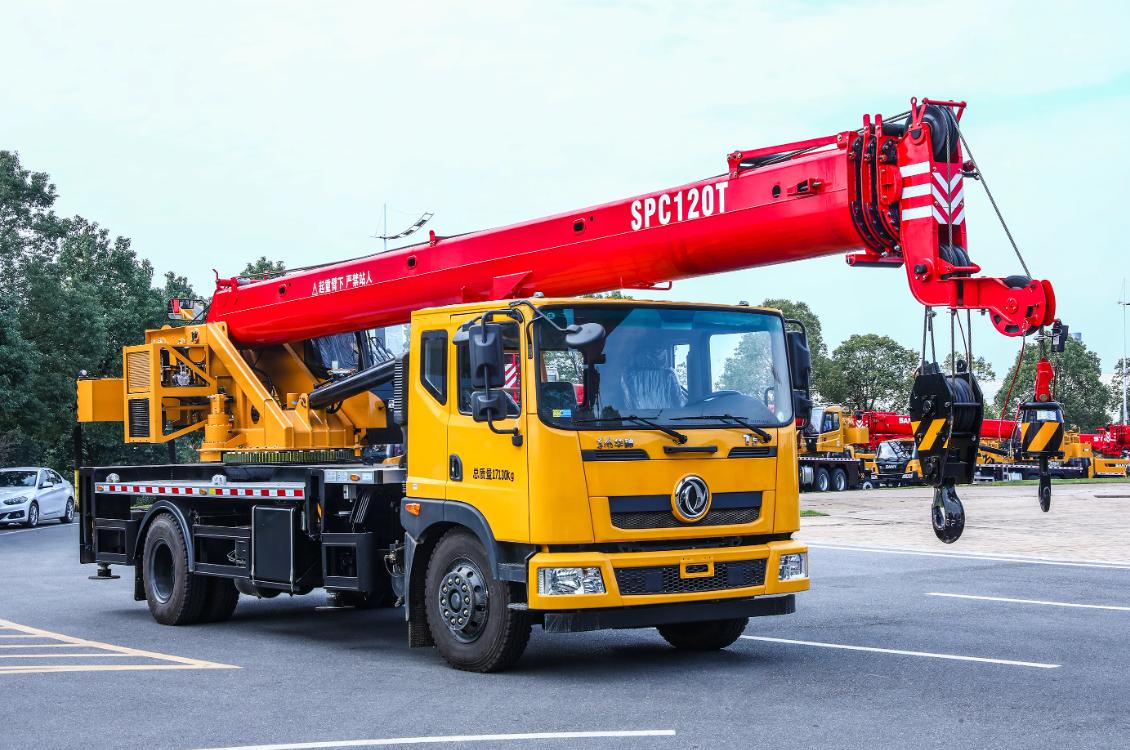
- Mobile Cranes offer good mobility and can quickly relocate to different job sites, making them ideal for various mobile operations.
- Crawler Cranes have low ground pressure and excellent off-road capabilities, making them ideal for lifting in complex terrains.
- Tire-Mounted Cranes combine the mobility of mobile cranes and some of the features of tower cranes, offering flexible usage.
How are construction cranes erected?
The erection of construction cranes typically requires site preparation, leveling the ground, and laying a solid foundation. Taking a tower crane as an example:
- Before installation, the site is leveled, and a concrete foundation is poured.
- A mobile crane is then used to assemble the base frame and foundation sections, followed by the installation of mast sections, which are bolted in place.
- The slewing device is installed next, and electrical and hydraulic systems are connected and tested.
- The jib, counter-jib, and counterweights are then installed. If the crane needs to be raised, a climbing section is used to hydraulically lift the upper portion and add additional mast sections.
- Finally, a thorough test and commissioning are conducted.
What materials can a crane lift?
Cranes are capable of lifting a wide variety of materials, including steel (such as rebar, steel pipes, and beams), precast concrete components (such as slabs, wall panels, and columns), building materials (such as bricks, sand, and cement), large equipment (such as elevators, boilers, and air conditioning units), and other heavy objects. However, different types and specifications of cranes have varying lifting capacities, which limit the weight and size of the materials they can lift.