Detailed Guide to Concrete Truck Weight and Selection
This article introduces concrete truck weight and how to choose the right equipment for your project to help your team perform better construction.
Concrete trucks are indispensable core transportation equipment in various construction scenarios, including highway infrastructure, real estate pouring, and municipal engineering. Operating on construction site roads and urban road networks, concrete trucks must ensure uniform concrete mixing while also considering driving safety and site adaptability. Therefore, concrete truck weight becomes a key consideration in selection and operation: What is the total weight of a concrete truck? What is the maximum weight of a full concrete truck? What working conditions are different tonnage models suitable for? This article will provide a comprehensive analysis of core parameters such as concrete truck weight and load capacity, and, combined with the needs of various construction scenarios, offer you a professional and practical guide to concrete truck selection.
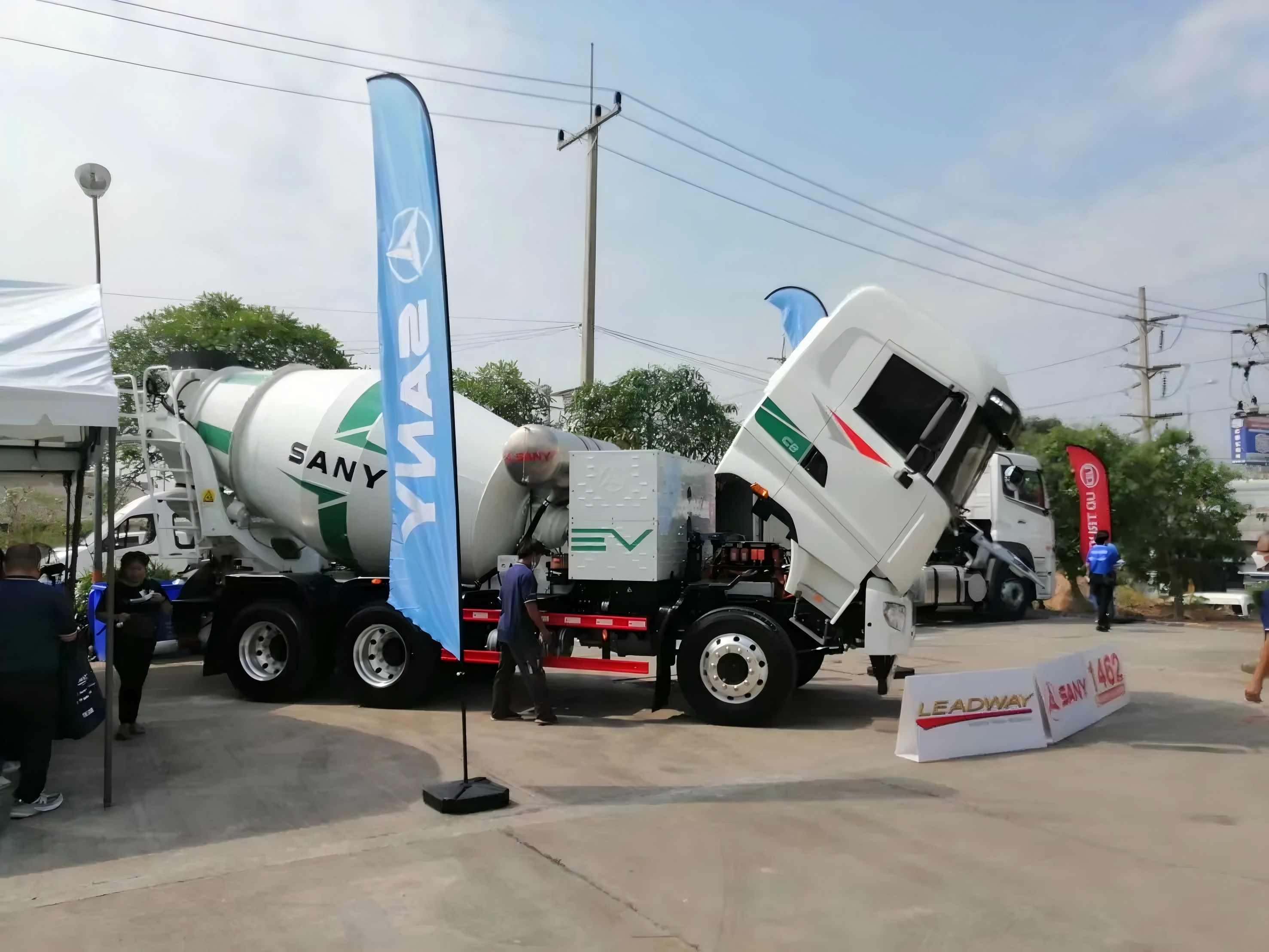
What Is the Weight of a Concrete Truck?
To understand “how much does a concrete truck weight”, we need to understand the relevant concepts. Generally, the weight of a concrete truck includes three core categories: empty weight, payload, and the total weight of the truck after loading concrete. Specific values depend on the truck model, capacity, and the density of the concrete.
Empty Weight
It is also known as tare weight, which refers to the basic weight of the concrete mixer truck itself without any concrete load. This includes the chassis, mixing drum, engine, etc. The empty tare weight of most mainstream models is generally between 15,000 and 30,000 pounds.
Payload
This refers to the weight of concrete that a concrete truck can transport. The weight of ordinary heavy concrete is approximately 4000 pounds per cubic yard. Lightweight concrete weighs approximately 3000 pounds per cubic yard. Including the remaining concrete in the mixing drum, the load capacity can reach 60,000–80,000 pounds.
Weight of a Full Concrete Truck
This is the total weight of the vehicle after it is loaded with concrete. If a mixer truck is loaded with 10 cubic yards of concrete, the concrete itself weighs approximately 40,000 pounds; the vehicle itself weighs approximately 26,000 pounds, for a total weight of approximately 66,000 pounds. Some larger models will be even heavier.
It is worth mentioning that there is a limit to the total weight of a vehicle, which is the most important figure for regulations. However, different countries have different limit standards for specific concrete truck types. For example, the United States limits the total weight of a single-axle, three-axle concrete truck to 48,000 pounds.
_153308.png)
How to Choose the Right Weight Concrete Truck for Your Project?
In concrete transportation, choosing the right weight for a concrete truck is not simply a matter of matching "how much it can carry." The core considerations are compliance, site safety, and transportation efficiency. The weight distribution effect of the axles is particularly crucial throughout the selection process. Road regulations limiting vehicle gross weight are only the foundation; stricter constraints lie in the load-bearing capacity of individual axles. Inappropriate weight selection can not only violate regulations and result in penalties, but also exacerbate road and bridge wear and tear, and even cause safety hazards such as site collapses.
Therefore, accurately selecting the appropriate mixer truck weight for a project requires a comprehensive assessment based on the project's actual needs, combined with factors such as axle configuration and site conditions. Specifically, the following methods can be followed:
Project Scale and Concrete Requirements
Calculate Usage: Estimate how many cubic meters (m³) of concrete the project requires.
Determine the mixing capacity: The selected concrete truck should have a mixing capacity sufficient for the project. For example, small projects may require 3-6 m³, while large projects may need 8-12 m³ (3.92-7.85 cubic yards) or even larger capacity mixer trucks. For instance, SANY truck mixers offer impressive transport efficiency, with their 37m Truck-mounted Concrete Pump capable of producing 48-160m³/hour (approximately 62.78-209.27 cubic yards/hour), meeting the transport needs of larger projects.
Construction Site and Accessibility
Space: Is the site large enough for large mixer trucks to turn and unload?
Ground: Is the ground level, and what is its load-bearing capacity? Muddy or narrow sections may require smaller or four-wheel-drive mixer trucks.
Self-loading Requirements: If self-loading is required, consider whether a self-loading mixer truck is needed, capable of simultaneously mixing and transporting.
Transportation Conditions
Distance: The length of the transport distance affects the initial setting time of the concrete; the insulation of the tanker and the time spent mixing need to be considered.
Road Conditions: Steep mountain roads or complex road conditions may require more powerful vehicles with fewer axles.
Vehicle Types and Performance
Standard Mixer Truck: Suitable for most situations, combining transport and mixing.
Specialty Vehicles: Such as four-wheel drive, off-road mixer trucks, suitable for harsh road conditions.
Self-loading Mixer Truck: Suitable for remote sites or sites requiring rapid and flexible deployment.
Consider Pumping: Mixer truck unloading speed and height, or whether it needs to be paired with a concrete pump truck.
Key Auxiliary Tool: Overcoming Load Capacity Limitations Through Axle Configuration
When projects require transporting more concrete, but single-axle weight is subject to regulatory restrictions, axle configuration becomes the core means of overcoming load capacity bottlenecks. The standard single-axle, three-axle configuration's load limit (48,000 lbs) is only sufficient for small projects. To increase load capacity, additional axles can be added: The added "lifting axle" and "thrust axle" distribute the load over a larger area, ensuring that the weight of each axle meets regulatory limits while significantly increasing the overall vehicle weight.
For example, four-axle, five-axle, and six-axle vehicles have a larger total weight and can legally transport more concrete, making them suitable for the large-volume transportation needs of medium and large-scale projects.
Regulations and Costs
Load Restrictions: Understand local restrictions on axle load and gross vehicle weight for construction vehicles.
Rent vs. Purchase: Decide whether to rent or purchase based on project timeline and budget.
Concrete Truck Daily Operation Precautions
As a core piece of equipment for transporting construction materials, besides selecting the right concrete truck for its weight, the standardization of daily operation directly impacts construction progress and on-site safety. From pre-departure vehicle condition checks and stable tank rotation en route to operational control during unloading, every step must be precise and strictly adhered to operating procedures to ensure stable equipment operation and that the concrete meets performance standards.
1. Pre-operation Preparation
Pre-operation Inspection: Check the condition of brakes, tires, all fluids, and lights; ensure the rearview camera and warning lights are functioning properly; confirm the drum is empty, clean, and rotates smoothly.
Equipment Preheating: After the engine is preheated, rotate the drum at low speed to bring the hydraulic system to operating temperature.
Water Tank Preparation: Fill the water tank and purge any air; after winter operation, completely drain the water tank to prevent freezing.
2. Driving and Transportation
Safe Driving: Maintain a speed of 40-60 km/h, keep a safe distance from the vehicle in front, and avoid sudden braking/acceleration; ensure the unloading slide is securely fixed.
Tank Specifications: During transportation, the tank of a large mixer truck must not be stopped (to prevent concrete from hardening and damaging the hydraulic system); the tank must not be stopped when empty/unloaded (to avoid collision between the rollers and support wheels).
3. On-site Unloading
Safety Positioning: Park on stable ground, use outriggers to keep the vehicle level, and avoid overhead lines.
Communication and Operation: Communicate clearly with on-site personnel; before unloading, rotate the drum at 10-14 rpm to carefully control the position of the unloading chute.
Prohibited Behaviors: Do not reverse when the hopper is lowered; personnel are prohibited from entering under the hopper; do not exceed the vehicle's load limit.
4. Protection and Finishing Procedures
Personal Protective Equipment: Wear goggles, gloves, a mask, and appropriate work shoes/clothing during operation to protect against cement dust and splashes.
Equipment Cleaning: After each use, immediately rinse the chute, hopper, and inside of the drum with high-pressure water.
Conclusion
In summary, concrete truck weight is the core anchor point for mixer truck selection and operation. Precise control of the weight from empty truck to fully loaded total weight is crucial for both regulatory compliance, site adaptability, and transportation efficiency. Choosing the right weight and strictly adhering to operating procedures are essential to ensuring both concrete quality and safety and efficiency in various projects. Whether it's bulk transportation in highway infrastructure or flexible scheduling in municipal engineering, scientific management centered on concrete truck weight is the key guarantee for efficient and safe progress in concrete transportation.
FAQs
How Much Does a 9 Yard Concrete Truck Weigh?
This includes approximately 36,000 pounds of concrete (based on roughly 4,000 lb per cubic yard), combined with an empty truck weight typically ranging from about 15,000 to 30,000 pounds. The exact total weight varies by truck model, axle configuration, and regional regulations, and is typically kept within applicable legal road weight limits.
How Many Tons of Concrete Can a Concrete Truck Carry?
The amount of concrete a concrete mixer truck can carry depends on the tank volume and the density of the concrete (generally assuming 2.4 tons/m³). Common capacities are 6-12 m³, which translates to approximately 14.4 tons (6 m³×2.4 tons/m³) to 28.8 tons (12 m³×2.4 tons/m³). Three-axle trucks typically carry 10-12 m³, while four-axle trucks can carry 15 m³ or even more; however, overloading should be avoided.
How Much Concrete Can a Concrete Truck Carry?
The amount of concrete a concrete truck can carry depends on the specific vehicle type and is affected by factors such as legal restrictions, truck type, and mix proportions. Specifically, Common concrete mixer trucks typically carry around 8 to 12 cubic yards, suitable for local delivery.
Large commercial mixer trucks can carry 10-12 cubic yards, used for larger pours or longer distance transport.
Small volumetric or transport mixer trucks may carry 2-6 cubic yards, suitable for confined spaces or small projects.
What Factors Affect the Weight of a Concrete Mixer Truck?
Factors affecting the weight of a concrete mixer truck include the truck's base weight (chassis, engine, drum), the volume and density of the concrete (affected by mix design, water usage, and admixtures), and the amount of residual concrete in the drum. All of these factors must be weighed against legal restrictions such as the vehicle gross vehicle weight rating (GVWR) and wheelbase limits.
Featured Products
_155548.png)

-OE_160931.jpg)
Recommend Blogs
Understand Concrete Trucks Cost, Control Construction Budgets
This article details concrete trucks costs, compares purchase and rental models, analyzes key cost factors, and guides contractors in selection to aid cost control.
What Is Concrete Truck Volume? A detailed and practical guide to model selection
What is the concrete truck volume? The following article will detail the calculation method for concrete usage and efficient delivery techniques.
Cement Truck vs Concrete Truck: Key Differences and Selection Guide
Cement truck vs concrete truck: Are they the same? This article will provide a detailed answer to help you choose the right truck for your construction project.